
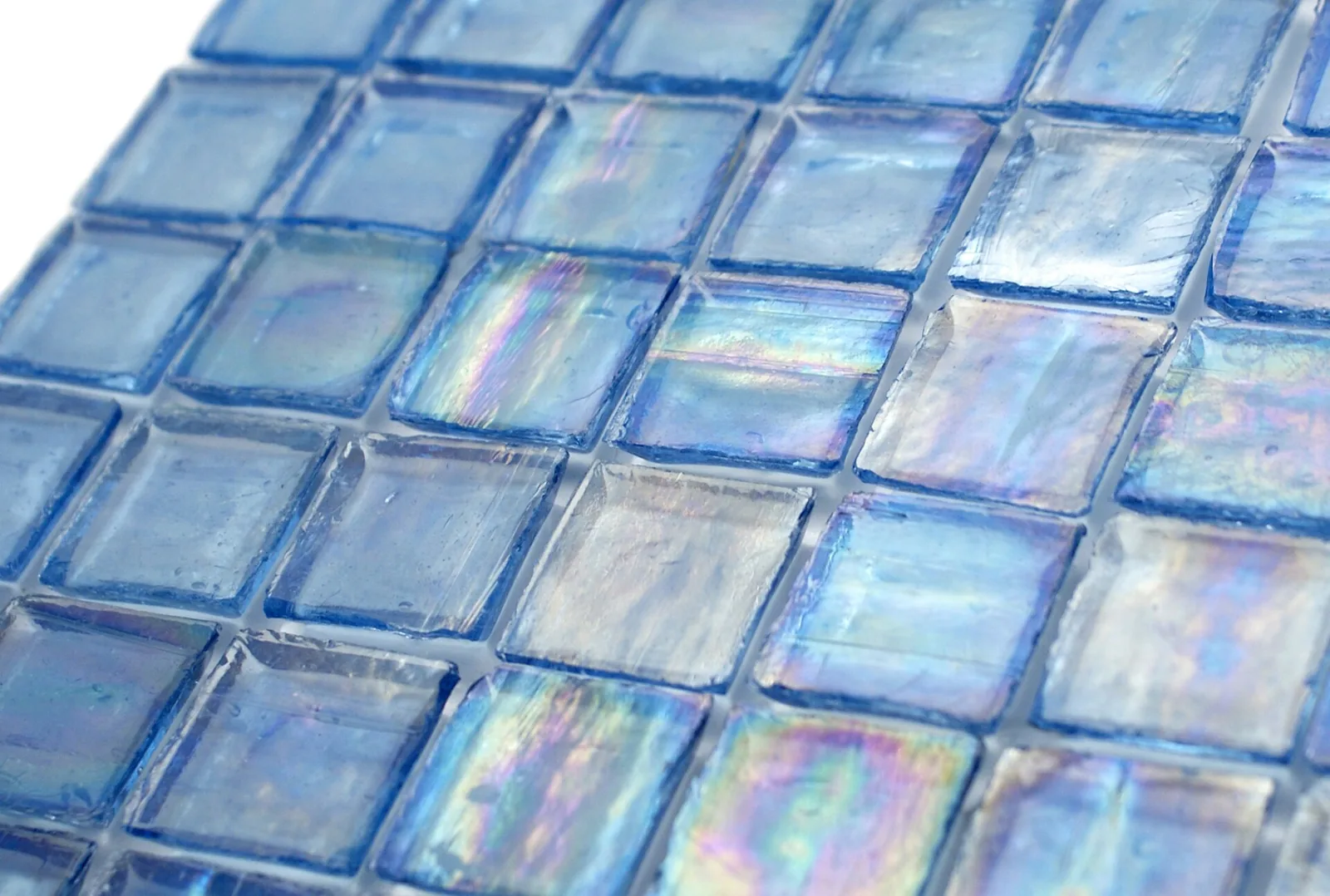
Sealing pool tile & glass mosaic · Perth
Beat the waterline scale on glass mosaic and pool tile.
Glass mosaic and glazed pool tile are one of our sweet spots. We seal them with GlassProtect: the one and only next-generation sol-gel surface protective coating in Australia. It bonds a clear nano layer onto the glass and glaze and drops the surface energy right down, so water beads and sheets straight off and the tile largely keeps itself clean. Through the season it does most of the work of staying clean itself, and the cleaning that is left gets far easier. It repels oil as well as water, and helps protect the glass and glaze from permanent etching.
The prettiest tile in the yard, the hardest to keep
Glass mosaic looks stunning, until the water gets to work.
Glass mosaic and glazed pool tile barely absorb, so they don't stain from below the way stone does. That was never the problem. The problem sits on the face of the tile, right where the water meets it, and in Perth's hard water and sun it builds up faster than most people expect.
At the waterline
The chalky calcium line
Where the water evaporates it leaves its dissolved minerals behind on the tile, and that hardens into the chalky white scale line every pool owner knows. Left alone it crusts over the glass and dulls it, and shifting it usually means acid, a pumice block and a sore back.
On the face
Scum and dulled sparkle
Sunscreen, body oil and the greasy scum they leave cling to the tile and cloud the glass. That is what turns a bright mosaic flat and grey. Water alone won't lift it, because the film fouling the tile is oily, not watery.
All season
The cleaning never stops
Because the scale and the scum key straight onto the glass, keeping the tile clear becomes a constant chore, and the aggressive descaling that shifts it can dull the very surface you are trying to save. That cycle is the real cost, and it is exactly what a low-energy surface breaks.
The point most people miss: pool tile doesn't have an absorption problem. It has a surface-energy problem. Everything that dulls it is sitting on the glass, waiting to be released or waiting to be cleaned off.
How GlassProtect works on the tile
A clear layer bonded to the glass.
Glass mosaic is glass, and a pool-tile glaze is a vitrified, glassy surface. Both carry reactive silanol groups, and that is what GlassProtect is built to grip. It condenses a clear Si-O-Si nano layer, around 75 to 100 nanometres, right onto the surface, and drops the surface energy so scale and scum can't hold on.
Bonds onto the glass, not on top of it
The coating chemically condenses to the tile's own silanols as it cures. It isn't a film laid over the mosaic that can peel or cloud. There is nothing sitting on top to lift, so the sparkle stays exactly as it was.
Water sheds, so far less is left to scale
Water beads and rolls, and because the sliding angle stays low, droplets carry their minerals off the tile before they dry into a scale line. There is simply less mineral left sitting on the glass to build up, and the oily scum a water-repellent-only surface can't shed gets released too.
It helps protect the glass from permanent etching
Keeping hard water from dwelling and drying on the tile is what protects the glass and glaze from the permanent etching that scale and mineral water leave behind, the kind you can no longer clean off. And it stays colourless, optically clear at around 99 percent, so the mosaic looks like itself.
Where the edge really lives
Built for the harshest spot in the yard.
The waterline is about as punishing as an outdoor surface gets: chlorine or salt, relentless UV, wet and dry every day, sunscreen and body oil, and the cleaning you give it to keep it clear. The protection has to live at the surface, where all of that lands. That is exactly where GlassProtect sits, and it is why it keeps working long after a spray-on repellent has washed away.
Cleaning & abrasion
Survives the brush and the descale
This is the load that wears most coatings off. GlassProtect is tested 3x more durable than the leading brand, and it is still beading around 100 degrees after 3,000 cream-cleanser scrub cycles, where a spray-on repellent is gone within a month. Because scale lifts far more easily, you also stop reaching for the aggressive descaling that dulls the tile. When it does eventually ease back, it renews with a top-up, no stripping.
Chemical
Stable through pool chemistry
The bonded inorganic surface stays stable through the chlorinated or salt water and the routine tile cleaners of ordinary pool maintenance. It is more resistant than an organic coating, not immune, so we tell you plainly not to leave a strong acid descaler pooled on it to dry.
UV
Doesn't yellow in the sun
A poolside tile bakes in full Perth sun all summer, and that is what ages a coating fastest. GlassProtect is inorganic, so it doesn't yellow or chalk the way an organic film does. It holds up under the UV that clouds lesser treatments, far more UV-resistant, though never UV-proof.
Oil & grease
Lifts the sunscreen scum, not just water
The film that greys a pool tile is oily: sunscreen, body oil and the scum they form on the water. A water-repellent-only surface still gets wetted by it. GlassProtect repels oil as well, so that scum sits on top and lifts in cleaning instead of clinging to the glass.
The whole wedge in one line: we protect the surface where the surface is used. A spray-on repellent that washes off in a fortnight of pool water never gets the chance to.
Proven, not promised
Still beading after the scrubbing.
The real test of a tile coating isn't the day it goes on. It is whether it survives the brush, the cream cleanser and the scale you fight at the waterline all season. That is what wears a coating out, and it is exactly what GlassProtect is built for.
- 3x more durable than the leading brand. Around 3x slower repellency loss in comparable cream-cleanser abrasion testing.
- Still beading at 3,000 scrub cycles. Retaining roughly a 100-degree water contact angle where many coatings wipe off within a month.
- Independently tested. At recognised houses including TÜV Rheinland, SGS, Intertek and REACH, and registered under the JUMBOGUARD guarantee on the coating's repellency function.
The honest limits
What it does, and what it doesn't.
We would rather you knew the edges up front. A coating that keeps pool tile shedding scale and scum is a genuinely good thing; it just isn't magic, and anyone telling you otherwise is overselling.
It won't rewrite your water
Hard water still leaves minerals when it evaporates, so scale can still form. What changes is that water beads and sheets off, so the tile largely keeps itself clean and most of what would settle simply runs off. You still clean the tile, just far less and far more easily.
The waterline is the win, not underwater
The biggest gain is at and above the waterline, where the scale, the scum and the cleaning happen. Continuous submersion is the harshest exposure there is, so on the fully underwater tiles we will tell you honestly what to expect.
It isn't armour
It changes surface energy, not hardness. It won't make a tile scratch-proof, and a pumice block or a wire brush still marks the glass. It is a shed-and-wipe coating, not a shield you can feel.
Long-lasting, not permanent
It degrades slowly and predictably and tops up over time. The visible bead is the first thing to ease off, and it fades before the shed-and-wipe performance does, so lost beading is your cue to have us re-test, not proof it has failed.
Common questions
Pool tile, answered.
What causes the chalky white line on my pool tiles?
It is calcium scale. At the waterline the water evaporates and leaves its dissolved minerals behind on the tile, and over time that hardens into the chalky crust every pool owner knows. GlassProtect lowers the surface energy of the glass and glaze so water beads and sheets off the coated tile, carrying most of the minerals away before they can dry, and the tile largely keeps itself clean so what cleaning is left gets far easier.
Will it stop the waterline scale coming back for good?
The tile largely keeps itself clean, which is the real win. Because water beads and sheets off the coated glass faster, most of the minerals leave with it before they can settle, so what cleaning is left gets far easier and you go from a constant chore to the glass doing most of the work. To be straight with you, no coating changes your water chemistry, so hard water still leaves some minerals when it dries; the difference is that they no longer bond and grip, so they wipe away instead of crusting in.
Does sealed glass still need any upkeep?
The hard part is done for you. Because GlassProtect makes water bead and sheet off the glass, most of it runs off carrying its minerals with it, and the tile largely keeps itself clean so the cleaning that is left gets far easier and far less frequent. It repels oil as well as water, so sunscreen and body scum are released in cleaning too, not just water. And by keeping hard water from dwelling and drying on the surface, it helps protect the glass and glaze from the permanent etching that would otherwise set in for good. It is not glass you never touch, it is glass that does most of the work of keeping itself clean.
Does it work on the submerged tiles under the water too?
The biggest win is at and above the waterline, where the scale, the scum and the cleaning all happen, and that band is exactly where GlassProtect earns its keep. Continuous submersion is the harshest exposure there is, so on the fully underwater tiles we would rather tell you honestly what to expect than overpromise. We walk you through it at the quote.
Chlorine pool or salt pool, does it hold up?
Yes. GlassProtect is an inorganic sol-gel coating, so chlorine and salt do not break it down the way they oxidise an organic film. It is stable through routine pool chemistry, more resistant than an organic coating, not immune. We assess your pool at the quote and seal it to suit.
Will it change the look of my glass mosaic?
No. It is a clear nano layer, roughly 75 to 100 nanometres thick and optically clear at around 99 percent. The colour, the sparkle and the finish of the mosaic stay exactly as they are. The only change is that scale, scum and minerals no longer grip.
How long does it last on pool tile?
It is a long-lasting treatment, not a permanent one. GlassProtect is tested 3x more durable than the leading brand and is still beading after 3,000 cream-cleanser scrub cycles, and when it eventually eases back it renews with a top-up rather than a strip. Every job is registered under the JUMBOGUARD guarantee on the coating's repellency function, which sits on top of your rights under Australian Consumer Law.
Keep reading
Related surfaces & where to next.
Same family
Glazed porcelain tile
The same clean-wipe coating for a glazed porcelain floor or wall, indoors and out. Read the guide
Same family
Polished / lappato porcelain
A polished porcelain face shows every smear and fingerprint. How GlassProtect keeps it clear. Read the guide
Same family
Matte / honed porcelain
The matte finish that grips grime hardest of all, and what a low-energy surface does for it. Read the guide
Same family
Full-body / technical porcelain
Unglazed, through-body porcelain: a less vitreous face, an honest limit we'll walk you through. Read the guide
Pool & waterline
Protecting pool surrounds
How pool water treats tile, coping and every surround material, and what keeps scale and scum wiping off. Read the guide
Browse everything
The Sealing Library
Every common hard surface in WA, graded by how well our coatings protect it. Find your surface
Ready to book
Get a quote for your pool
Whole-home GlassProtect starts from $495, confirmed before you book, registered under the JUMBOGUARD guarantee. Get a quote
Get a quote
Seal your pool tile once.
We'll prepare and seal your glass mosaic and pool tile with GlassProtect, the right JUMBOGUARD coating for the surface, registered under a JUMBOGUARD guarantee: 10 years on new glass, 5 years on existing glass. Confirmed price before you book.