
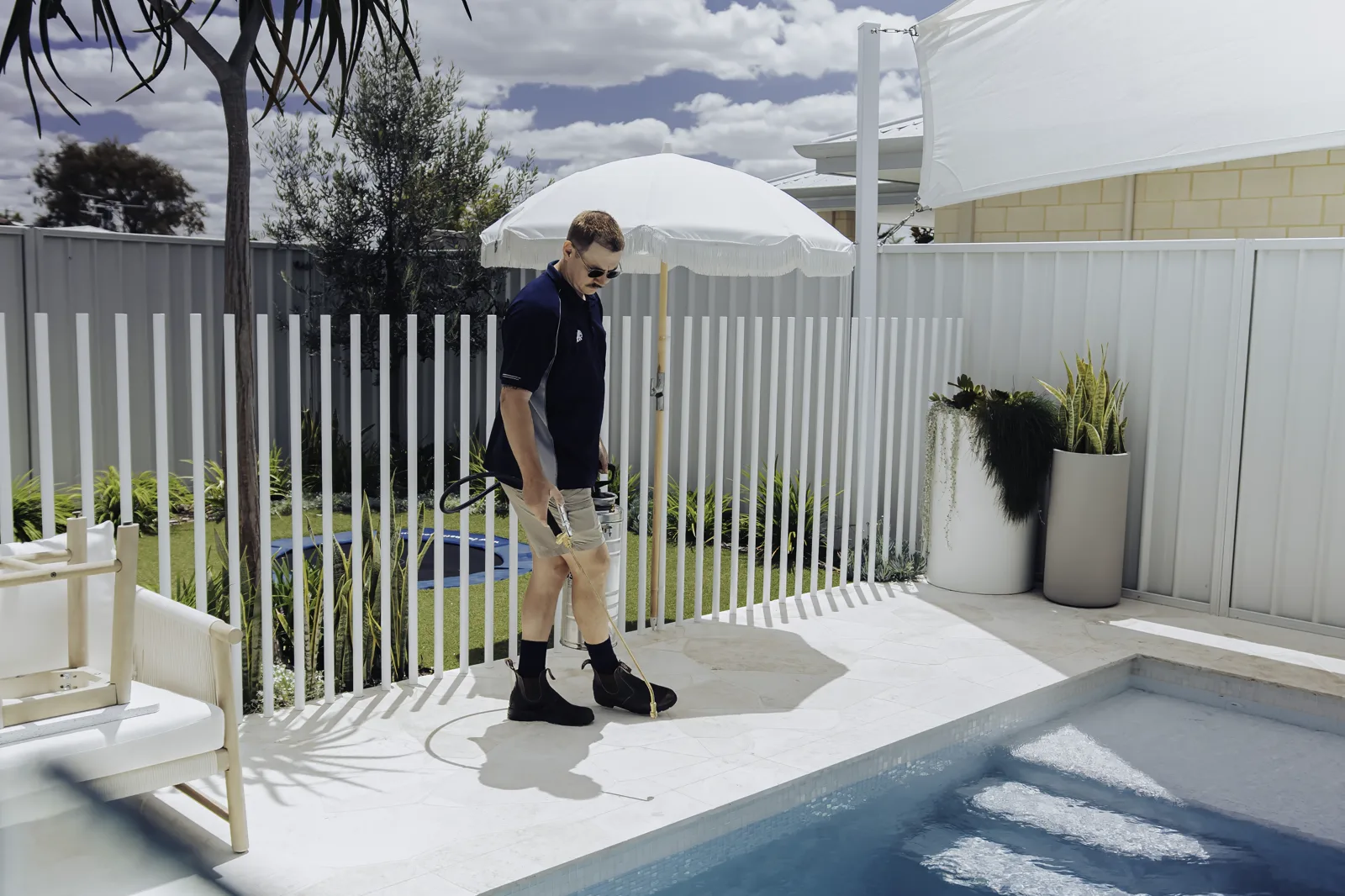
Sealing guide · Perth
How to protect pool surrounds in Perth.
Pool paving cops more than any other surface in the yard: salt, chlorine, sunscreen and a constant wet-and-dry cycle in full WA sun. Seal it with a breathable coating that anchors into the surface and shrugs off the routine pool chemistry, and it keeps its colour and sheds the mess. The honest bit up front: that means more resistant, not immune, and nothing makes stone acid-immune.
The short answer
Breathable coating, right material.
If you want the quick version: most pool surrounds in Perth are porous stone or concrete, travertine, limestone, exposed aggregate and the like, and they cope well with sealing. Use a breathable coating that bonds into the surface rather than a film that lays on top. It sheds the salty, sunscreen-loaded splash at the surface, keeps your colour, and still lets the stone dry out so salt is not trapped behind a seal. What it will not do is make carbonate stone acid-immune, so keep concentrated pool acid off the coping. See how our pool paving sealing in Perth handles the coping and surround.
Do this
Seal it breathable
Pick a coating that anchors into the mineral and lets moisture escape. It protects at the surface where the splash lands, and because the stone can still breathe, salt is not sealed in to crystallise and flake it off.
Not this
Not a film on top
A topical film around a pool is the worst place for one. Constant wet-and-dry, UV and pool splash lift and yellow it, it can turn slick when wet, and when it fails it has to be stripped back to bare before you can start again.
Know this
Resistant, not immune
The coating stands up to routine chlorine and salt-water splash. Concentrated pool acid used for dosing is a harsher thing, and no sealer makes carbonate stone acid-immune. Dose into the water, not over the coping, and rinse splashes.
Why pool paving is the hardest surface you own: it is the only part of the yard that gets soaked and baked dozens of times a day, in water carrying salt, chlorine and sunscreen, in the harshest UV on the block. That combination is what wears an ordinary seal out in a season. The rest of this page is what actually holds up against it.
The four things hitting it
Salt, chlorine, sunscreen, and sun.
A pool surround is not fighting one thing. It is fighting four at once, all day, every warm day. This is why the seal your patio gets away with does not last the distance out here.
- Salt, from the pool and the coast. Salt-chlorinated water splashes out, soaks into porous stone, then dries. The salt stays behind and crystallises inside the surface, and that expansion is what flakes and pits soft stone like Tamala limestone over time.
- Chlorine and pool chemistry. Chlorinated splash-out is constant. Routine levels are fine for a coating built for it, but they slowly bleach and break down ordinary sealers and can lift the colour out of unsealed stone.
- Sunscreen and body oils. The greasy stuff swimmers leave behind is oil, and oil is what actually stains stone for good. Water-repellent-only sealers do not stop it. It soaks in around the steps and coping and darkens them.
- The wet-and-dry cycle, in full sun. Soaked, then baked, then soaked again, dozens of times a day. That cycle is the real killer: it drives salt in and dries it out, and it is what breaks a seal down faster here than anywhere else in the yard.
What's actually in your pool water
Salt, chlorine or mineral, they hit the stone differently.
People ask whether a salt pool is kinder to paving than a chlorine one. The honest answer: the sanitising system changes the detail, but every system lands the same short list of loads on the stone. Here is what each one actually does.
Salt-chlorinated
The salt is the story
A "salt pool" is still sanitised by chlorine, made from the salt by the chlorinator. For your paving the extra factor is the salt itself: it splashes out, soaks into porous stone and crystallises as the surface dries. On soft stone that expansion is the main thing that flakes and pits it over the years.
Chlorine, liquid or tablet
An oxidiser, and a pH swing
Chlorine is an oxidiser that slowly breaks down organic sealers. The catch is pH: liquid chlorine runs alkaline, while stabilised tablets run acidic, and chronically low pH or an undissolved tablet resting against the coping is where localised acid etching of carbonate stone comes from.
Mineral & magnesium
Gentler water, still salts
Mineral and magnesium systems are easier on skin and usually run a low chlorine level, but they are still dissolved salts, so the same soak-in-and-crystallise story applies to porous stone. Copper-based ioniser systems carry one watch-point: if the water drifts, copper can stain stone, plaster and grout a blue-green, and that is a water-chemistry issue, not a coating one.
The lever most people miss: whether your water tends to etch the stone or leave a chalky white bloom comes down to water balance, mainly pH, calcium hardness and total alkalinity (your pool tech calls it the saturation index). Water that runs "hungry" and under-balanced dissolves calcium out of carbonate stone, plaster and grout and dulls them; water that runs over-balanced drops calcium carbonate back out as white scale on the coping and tile. Balancing that water is your pool professional's job, and it is the fix at the source. Protecting the surface is ours. Two separate clocks, and you want both running right.
Why a breathable coating wins here
Shed the water. Let the stone breathe.
The trick around a pool is to keep most of the salty, oily water out at the surface, without sealing the stone up so tight it cannot dry. A film does the first and fails the second. A coating that bonds into the surface does both.
It anchors into the mineral
Our mineral sol-gel is not a film laid over the paving. It bonds into the surface as an inorganic network, so there is nothing sitting on top to lift, yellow or turn slick, which is exactly what happens to a topcoat around a pool.
It sheds the salty, oily splash at the surface
Water beads and runs off carrying most of its salt with it, and the sunscreen and body oil that would soak into bare stone sits on top and lifts in a wash instead of staining. The protection lives where the splash actually lands.
And it still lets the stone breathe
Because it works at the surface instead of plugging the stone up, moisture can still escape. That matters most around a pool: a film that seals water in lets salt crystallise underneath and flake the surface off from behind. Breathable protection keeps the salt moving out, not trapped in.
That is the short version of the resistance edge. The full account of where protection lives, and why it holds up to cleaning, salt and UV, is in the pillar: the four real-world resistances. For how a seal ages and tops up over the years, see what a seal does, and what it does not.
Match it to your paving
What pool water does to each material.
Every pool surround is one of a few material families, and each one reacts its own way. Find yours for what is actually happening, how the coating behaves on it, and what going without looks like.
Calcareous stone · optimal
Travertine, limestone, tumbled limestone, marble
Carbonate stone. It reacts with acid, so low-pH or dosed pool water etches and dulls it, and no penetrating sealer stops that. It is porous, so salt crystallises inside it and minerals bloom on it. This is the sweet spot for a breathable coating: it anchors into the surface, stays colourless, and keeps the stone drying instead of trapping salt behind a film.
Siliceous stone · optimal
Granite, quartzite, sandstone, bluestone
Silicate stone. It is broadly acid-resistant, so pool acid does not etch it the way it does carbonate (not absolute, but close). It is still porous, though, so salt, sunscreen oil and mineral deposit are the real loads. The coating anchors hard into the siliceous surface and sheds the splash where it lands.
Concrete & cement-bound · optimal
Exposed aggregate, pavers, liquid limestone
Cementitious surrounds are porous and lime-rich, so they salt, effloresce and can be acid-etched, and they are usually the ones that came with a cure-and-seal film that whitened and peeled in the splash zone. The coating bonds concrete-class into the cement, keeps the grip, and tops up without a strip.
Pool tile & waterline · GlassProtect
Glazed & glass-mosaic tile, the waterline
Vitrified tile and glass mosaic do not soak water up, so the trouble is all on the surface: hard-water scale and an oily scum band at the waterline. No coating keeps minerals from landing on any surface, but on coated tile the deposit sits loosely and wipes off, where on bare tile it bonds on and, left to dwell, etches in for good. This is GlassProtect's job, not the stone coating.
The honest limit
More resistant. Not immune.
Here is the part a lot of sellers skip. Travertine and limestone are carbonate stone, and carbonate reacts with strong acid. Routine chlorinated or salt-water splash is not strong acid, and our coating stands up to it well. But the concentrated pool acid people use to dose the water is, and if it is splashed onto the coping it etches and dulls the stone for good. No coating, ours included, makes carbonate stone acid-immune. What sealing buys you is real resistance to the everyday chemistry and a surface that sheds instead of soaks, not a licence to tip acid over the stone. Dose it into the water, never over the paving, and rinse any splash straight away. That one habit protects a pool surround more than any product can.
Pool paving, answered
The real questions.
Can pool paving be sealed if it is always getting wet?
Yes, and it should be. The thing that ruins pool paving is not the wet, it is the wet-and-dry cycle. Water carrying salt and pool chemistry soaks into porous stone, then the Perth sun dries it and leaves the salt behind to crystallise inside the surface. A breathable coating is the right answer here: it anchors into the mineral and sheds most of that water at the surface, while still letting the stone dry out and breathe, so salt is not sealed in behind a film.
Will chlorine or salt water damage the sealer?
Routine pool chemistry is exactly what our coating is built to stand up to. It is an inorganic mineral network, so day-to-day chlorinated or salt-chlorinated splash-out does not break it down the way it slowly wears through ordinary sealers. The honest bound is that it is more resistant, not immune. Concentrated pool acid used for dosing, or chronically low-pH water, is a different and far harsher thing, and no sealer makes carbonate stone acid-immune.
What is the best sealer for pool surrounds in Perth?
For porous pool paving, a breathable coating that bonds into the surface rather than a film that sits on top. Films look good for a season, then the constant wet-and-dry, UV and pool splash lift and yellow them, and a failed film has to be stripped before you can redo it. A coating that anchors into the mineral protects right where the salt, sunscreen and cleaning hit, keeps the stone breathing so salt is not trapped, and tops up over itself without stripping. It is the one and only next-generation sol-gel surface protective coating in Australia, and nothing else works quite like it.
Will sealing make my pool paving slippery?
It does not lay down a glossy film that can get slick when wet the way a topcoat can. Because it bonds into the surface instead of forming a layer on top, it keeps the paving's own texture and grip. If you want the natural, non-glossy look, that is what a bonded mineral coating gives you by default, which matters most right around a pool where people walk in bare wet feet.
My travertine is going dull and rough where we dose acid. Can sealing fix that?
Sealing protects a good surface going forward, it does not reverse acid etching that has already happened. Carbonate stone like travertine and limestone reacts with strong acid, and concentrated pool acid splashed on the coping etches and dulls it for good. A coating makes the surface more resistant to the routine chemistry, but it is not acid-immune, and we will always tell you that straight. The fix for etched stone is honing or repair, then sealing what is restored. Dose acid into the water, never over the coping, and rinse any splash straight away.
Is a salt pool gentler on my paving than a chlorine pool?
Not really, it just shifts the detail. A salt pool is still sanitised by chlorine, made from the salt by the chlorinator, so you get the chlorine load plus the salt itself, and the salt is what soaks into porous stone and crystallises as it dries. A chlorine pool skips the added salt but swings on pH: stabilised tablets run acidic, and low pH or a tablet resting against the coping is where carbonate stone gets etched. Whatever the system, the coating protects the surface the same way, and the same honest limits apply.
I have a mineral or magnesium pool. Is that different?
Gentler on skin, much the same on stone. Mineral and magnesium systems still run dissolved salts, so porous paving still soaks them up and they still crystallise as the surface dries. If yours is a copper-based ioniser system, keep the water balanced: drifting chemistry can leave a blue-green copper stain on stone, plaster and grout, and that is a water issue no surface coating fixes. Tell us your system when we quote and we will read the surface accordingly.
Why does my stone go chalky and white, or dull and rough, near the pool?
Two different things, and it is worth knowing which you have. A chalky white bloom is mineral deposit and efflorescence: salt and calcium carried into the stone by pool splash and reticulation, then left behind as the water dries. A dull, rough, faded patch is etching: low-pH or dosed water dissolving the carbonate surface itself, which no sealer reverses. Which one you get is largely down to water balance, so the source fix is at the pool, and a breathable coating keeps the deposit sitting on the surface where cleaning lifts it rather than locking it into the pore.
What about the pool tiles and the waterline?
Different material, different job. Glazed tile and glass mosaic do not absorb water, so the problem is on the surface: hard-water scale and an oily scum band at the waterline. No coating keeps minerals from landing on any surface, but GlassProtect lowers the surface energy so what lands sits loosely and wipes off, instead of bonding on and, left to dwell, etching the glaze for good. That is a GlassProtect job, separate from the breathable coating we put on the stone.
Keep reading
Related guides.
Local · salt
Protecting coastal stone from salt
Same salt problem, the whole property. How breathable sealing keeps salt from flaking coastal stone and render.
Read the guideLocal · timing
The best time to seal in Perth
When to book pool paving so the coating cures right, and why the shoulder seasons beat mid-summer.
Read the guideThe science · pillar
The four real-world resistances
Where protection actually lives: cleaning, chemical, UV and oil, and the honest bounds on each.
Read the pillarLocal · water
Check your suburb's water
Reticulation and bore water vary hugely across Perth. Find your supply zone and see how hard your water runs on the coping.
Open the water toolSurface · tumbled stone
Tumbled limestone by the pool
The soft, open finish blooms and blotches fastest around water. What is happening on it, and how we protect it without changing the look.
Read the guideSurface · tile
Pool tile and the waterline
Scale and scum on glazed and glass-mosaic tile, and how GlassProtect keeps them wiping off instead of bonding on.
Read the guideGet a quote
Seal the pool surround once.
We clean and seal your pool paving with the right coating for the material, at $16/m² all-in, registered under a 10-year guarantee. You get the honest read on your surface, salt, chemistry and all, before you book.