
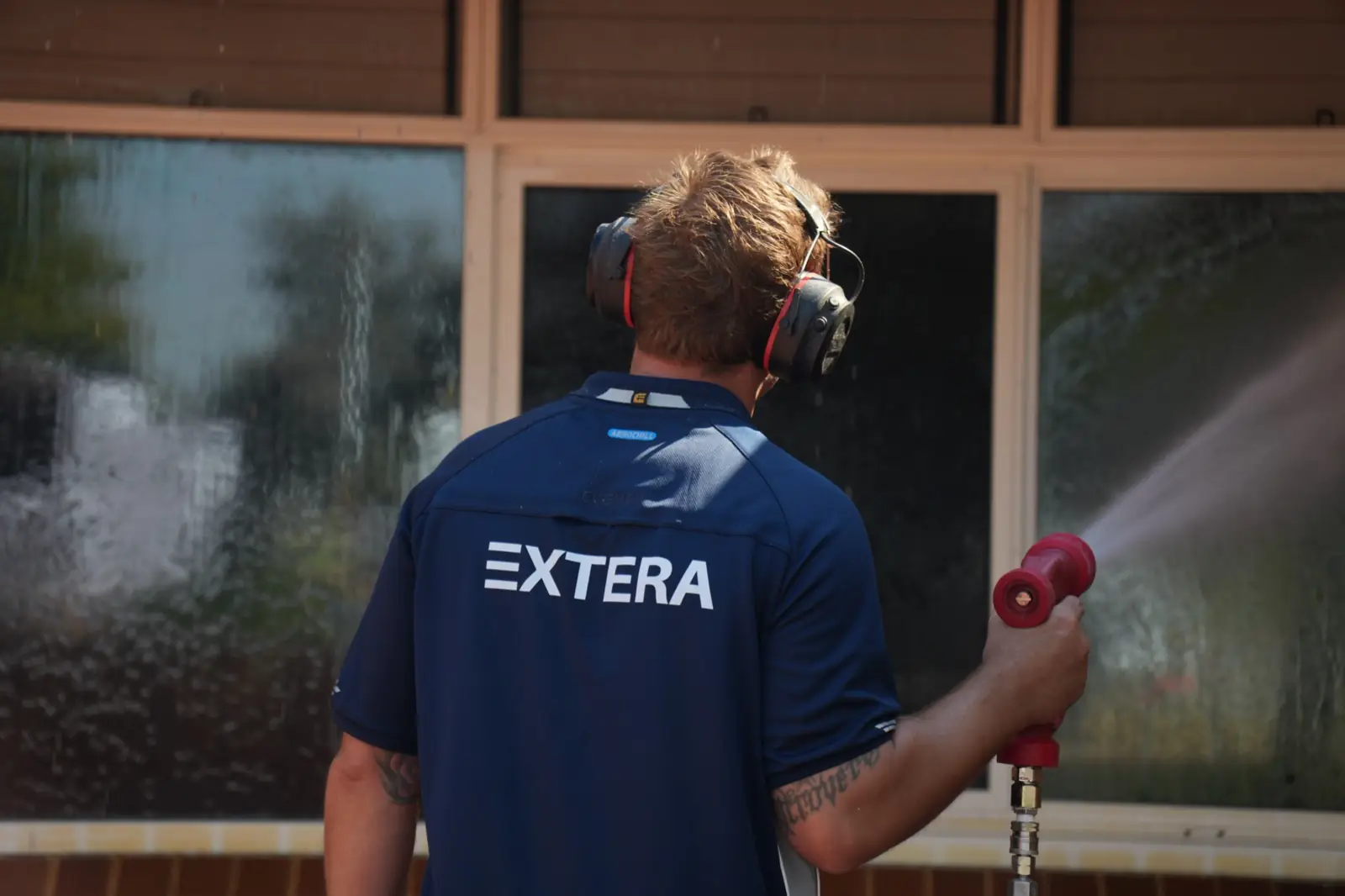
Window cleaning · Perth & South West
Window cleaning Perth, done to a sealing standard.
A streak-free clean on every exterior pane, high glass included. But in Perth the real enemy isn't the dust, it's the water. Bore water and reticulation overspray leave mineral spots that bake back on within weeks. So we clean the glass to the standard sealing demands, then we can protect it, so it keeps itself clearer for far longer. We clean it. Then we protect it.
The Perth problem
Your windows aren't dirty. They're spotted.
You clean the glass and within a fortnight the white marks are back. That isn't a bad clean, it's the water. Perth runs on bore water and reticulation, and roughly 75,000 domestic bores spray mineral-heavy water straight onto the glass. When a droplet dries on hot glass, the mineral stays behind. Under the summer sun it bakes on in minutes, and west-facing glass cops it worst.
Bore & reticulation
Groundwater at roughly 110 to 170 mg/L of dissolved calcium, magnesium and iron, sprayed onto the glass every morning.
Sun bakes it in
Droplets dry within minutes on hot glass, leaving the mineral fused to the surface. West-facing panes suffer most.
Coastal salt film
Near the coast the sea breeze lays down a salt haze that dulls the view and returns fast between cleans.
Summer red dust
Easterly wind events carry red dust that dirties glass overnight, on top of new-build construction dust.
White cloudy spotting
Calcium and magnesium scale, the same minerals that fur up a kettle. It reads as a milky haze or hard little dots you can't wipe off. This is the common one across most Perth suburbs.
Orange or rust staining
Iron carried in bore water, oxidising on the glass into brown or orange streaks. Different deposit, different treatment. We identify which one you have before we touch the glass.
A proper clean
What a professional clean actually involves.
A real window clean is more than a wipe over. It's the right method for each pane, ground floor to facade, with the add-ons most people expect done at the same time. We clean to the standard sealing demands, because a bonded coating only lasts on glass that was genuinely clean and prepped first.
Squeegee & scrim, low glass
Ground-floor glass is washed, bladed off with a professional squeegee and finished with lint-free scrim, so it dries clear with no streaks and no towel fluff in the corners.
Pure water for high glass
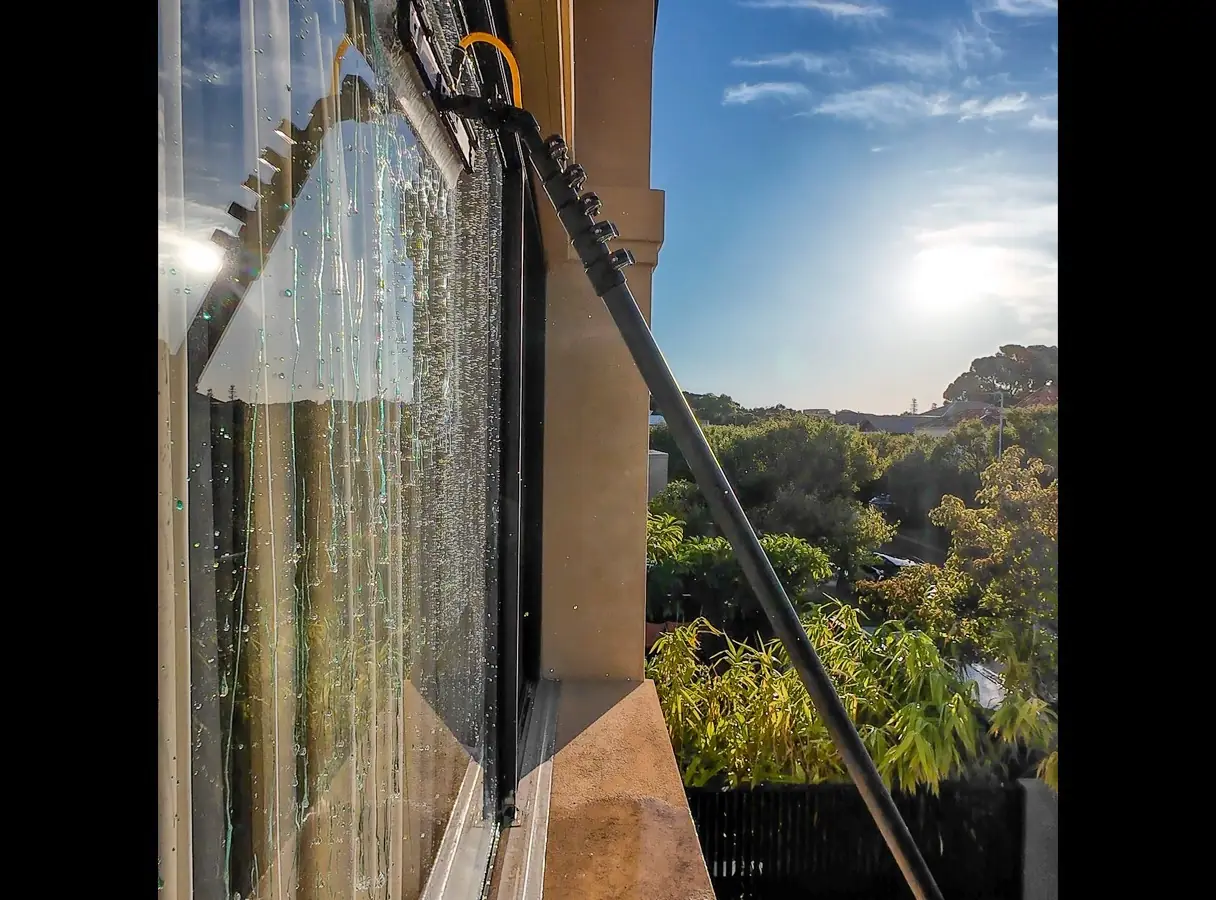
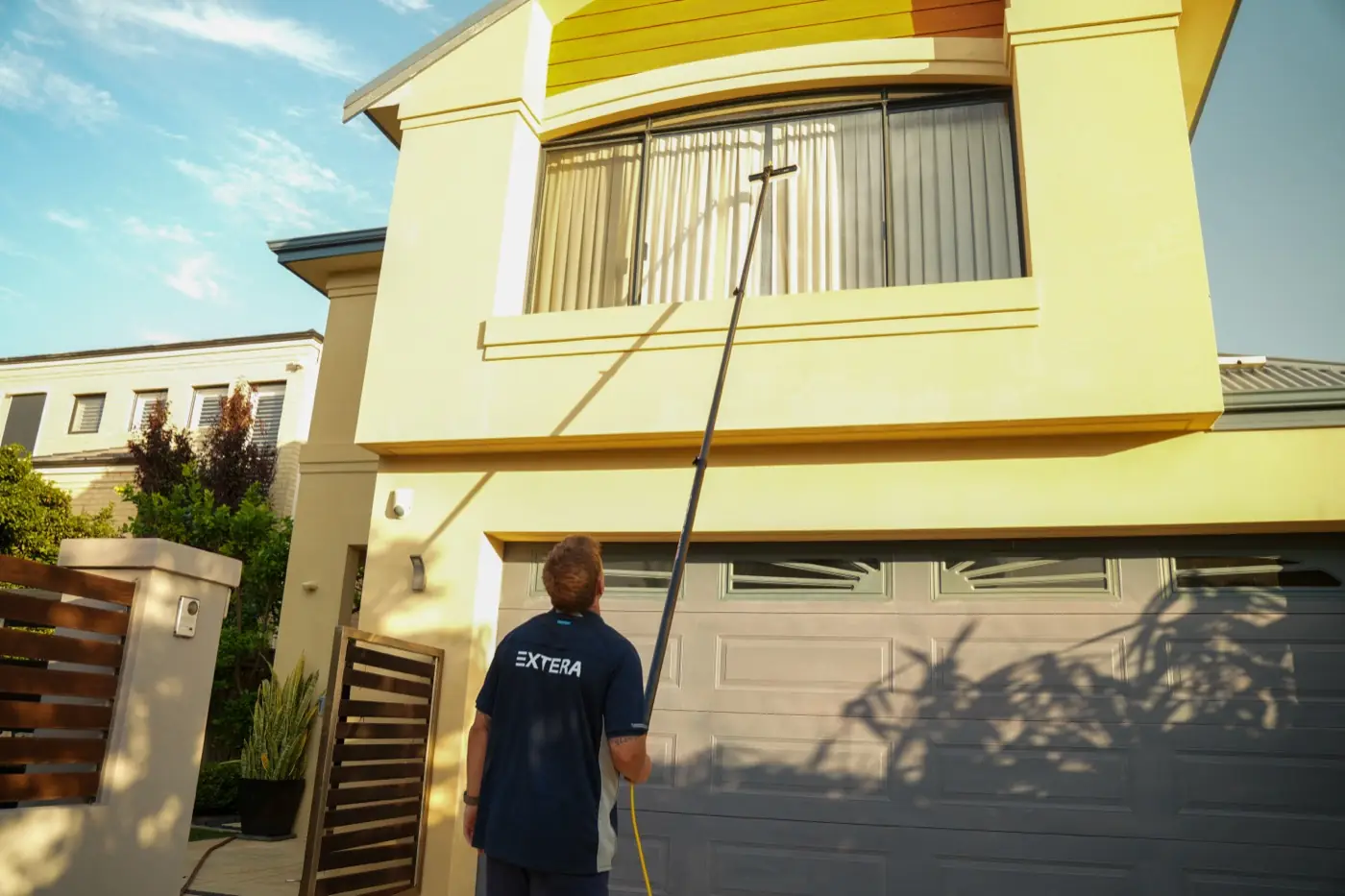
Second-storey and facade glass is reached from the ground with a water-fed pole running deionised pure water. It rinses clean and dries without streaks, with no ladders leaning on the glass.
Exterior glass
We clean the outside of the glass. That's the face bore water, reticulation overspray and salt film actually land on, so it's the one that stains and the one worth protecting. Frames wiped down as part of the job.
Tracks, sills & flyscreens
The add-ons buyers expect: tracks vacuumed and wiped, sills cleared, flyscreens washed. Quoted with the clean, done on the same visit.
Solar panels
Cleaned with the same pure-water method. A mineral film on the panel cuts its output, so a clean pays you back in yield.
High & facade glass, the big win
The hardest glass to reach is the most expensive to clean again, and the most worth protecting once it's clear. This is where the whole approach pays off fastest.
What it costs, and how often
We clean the exterior glass only, which is the face Perth's bore water, reticulation overspray and salt film actually land on. As a guide to the market, an exterior-only clean on a single-storey home typically runs around $175, and a double-storey home around $450 to $550. Some cleaners charge hourly, around $57 to $97. Frequency: twice a year is the baseline; near the coast, every three to four months keeps up with the salt film.
Those are typical market rates, not ours. We quote every job as one fixed, all-in price on your glass, the access and the add-ons you choose, so there are no hourly surprises. Small jobs carry a call-out minimum, confirmed at quote.
Method
Gentle pure water, not acid and abrasion.
How the glass is cleaned matters as much as whether it's cleaned. The wrong method leaves the glass worse than it started.
- We use pure water and soft tools. Deionised water rinses away clean with nothing left to dry into spots, and soft pads lift the deposit without scoring the glass.
- Acid strips and dulls. Vinegar and harsh chemical removers eat any protective coating and, used often, cloud the surface they were meant to clear.
- Abrasive pads and blades micro-scratch. Those fine scratches trap grime and haze the view permanently. You can't buff them back out.
- High-pressure blasting drives water past seals. On windows and frames it forces water behind the glazing and can lift finishes, which is why we don't blast glass.
Honest assessment
Deposit, or true etching? We tell you straight.
This is the part most cleaners skip, and it's the one that saves you money. Not all cloudy glass is dead glass.
- Surface deposit, the usual case. The mineral is sitting on top of the glass. A professional cerium-oxide restoration polish recovers around 95% of it, back to clear.
- True etching, the rare case. Minerals have eaten microscopic pits into the glass and taken material away. That part is permanent, and no clean or coating can put it back.
- We assess first. We look at the glass before we quote and tell you which one you're dealing with, rather than writing off glass that's fine or promising miracles on glass that isn't.
Now protect it
Clean glass re-stains. Sealed glass doesn't, as fast.
A bare pane starts spotting again with the very next sprinkler cycle. So the moment to protect the glass is while it's clean and prepped. GlassProtect is a clear bonded coating, a Si-O-Si layer around 75 to 100 nanometres thick, far thinner than a human hair. It lowers the surface energy of the glass so water can't wet it: droplets bead up and sheet straight off, carrying the minerals away before they can dry on. Self-cleaning by physics, not by chemistry.
- Up to 95% less cleaning. Rain and the occasional rinse do most of the work.
- Built to survive the squeegee. Still beading after 3,000 wet-scrub cycles in testing, and roughly 3 times more durable than the leading brand.
- Clear and invisible. No colour, no haze, no tint. The glass just looks like clean glass, until it rains.
- Applied by certified applicators, registered under the JUMBOGUARD guarantee.
The economics
Stop paying to clean it twice a year, year after year.
Cleaning is a cost you pay again every few months. Protecting the glass once is a single job that then does most of the cleaning for you for years. On the high and facade glass, where every clean is dear, it pays for itself the fastest.
Keep cleaning only
On the Perth market, roughly $275 to $550 a clean, twice a year or more. Over three to five years that's thousands, and the glass is bare and re-spotting between every visit.
Clean once, then protect
Restore the glass, then coat it, whole-home from $495. It keeps itself clearer for years, so the cleaning you do afterwards drops right off.
Not the DIY sprays
Off-the-shelf glass treatments sit loosely on the surface and tend to last months, which is why reviews on them run mixed. Ours is professionally applied, bonded, guaranteed and built to last.
The honest bit
It isn't maintenance-free, and we won't pretend it is. The coating wears back slowly and evenly rather than failing all at once, and it tops up without stripping the old layer off first. Think much less cleaning, not never cleaning. That's the difference between a coating that's built to last and one that's sold as permanent.
Scope
What we mean by window glass.
In scope
Architectural and house windows, glazing and facade glass, and glass balustrades. Exterior faces, single and double storey, across Perth metro and down to the South West.
Homes and commercial
Private homes, strata and commercial buildings alike. Shopfronts, offices and multi-storey facade glass are cleaned and quoted the same fixed-price way, then protected with GlassProtect where it earns its keep. For larger sites, see our commercial cleaning.
Browsing what else we handle? See all our cleaning services, or the suburbs and towns in our service area.
Questions, answered
Straight about Perth glass.
How much does window cleaning cost in Perth?
We clean the exterior glass only, which is the face Perth's bore water, reticulation overspray and salt film actually land on. As a guide to the Perth market, an exterior-only clean on a single-storey home typically runs around $175, and a double-storey home around $450 to $550. Some cleaners charge by the hour, around $57 to $97. We quote every job as one fixed, all-in price based on your glass, the access and any tracks, sills or flyscreens you want done, so there are no hourly surprises. Small jobs carry a call-out minimum, confirmed when we quote.
How often should I clean my windows in Perth?
Twice a year is the baseline for most Perth homes. Near the coast, salt film and the Fremantle Doctor build up faster, so every three to four months keeps glass clear. Summer easterly winds bring red-dust events that dirty glass overnight, and a new build wants a builders' clean once the trades finish, ideally before handover so the glass starts life protected.
Why do white water spots come back on my windows so quickly?
It is the water, not dust. Bore water and reticulation overspray across Perth carry dissolved minerals: calcium, magnesium and iron, at a typical hardness of around 110 to 170 mg per litre from roughly 75,000 domestic bores. When a droplet lands on hot glass it dries in minutes and leaves the mineral behind as spotting. West-facing glass in summer bakes it on fastest. It is not that the clean did not last, it is the sprinklers hitting the glass again the next morning.
What is the difference between the white spots and the orange or rust marks?
They are two different deposits. White cloudy spotting is calcium and magnesium scale, the same minerals that fur up a kettle. Orange or rust staining is iron carried in bore water, which oxidises on the glass. Both come from Perth groundwater and both are treated differently, so we identify which one you have before we touch the glass.
Can hard water stains be removed, or is the glass ruined for good?
Usually they lift. Most Perth spotting is a surface mineral deposit sitting on top of the glass, and a professional cerium-oxide restoration polish recovers around 95 percent of that. The one exception is true etching, where minerals have eaten microscopic pits into the glass and taken material away for good. We assess the glass first and tell you straight which one you have, rather than promising miracles or writing off glass that is actually fine.
Will vinegar or a scouring pad damage my windows?
Both can. Acids like vinegar strip any protective coating and, used often, dull the surface. Abrasive pads and blades micro-scratch the glass, and those fine scratches trap grime and haze the view in a way you cannot buff back out. We clean with pure water and soft tools that lift the deposit without scoring the glass.
Can you reach second-storey, high or facade windows safely?
Yes. Most two and three storey and facade glass is cleaned from the ground with a water-fed pole running deionised pure water, which rinses away clean with no ladders leaning on the glass. Taller commercial facades we assess and quote case by case. High glass is the hardest to reach and the most worth protecting, because it is the most expensive to clean again.
Does a glass coating actually work, and is it worth the money?
Yes, and the physics is simple. GlassProtect lowers the surface energy of the glass so water can no longer wet it: droplets bead up and sheet off instead of clinging and drying into spots. Less water dwelling means less mineral left behind to bake on, which works out to up to 95 percent less cleaning. It will not make glass self-cleaning in a vacuum, but on Perth glass hit by sprinklers and salt it does most of the work for you.
How long does a glass coating last, and does it ever wear off?
It is not forever, because nothing on glass truly is. Bonded properly, GlassProtect is roughly 3 times more durable than the leading brand and still beads after 3,000 wet-scrub cycles in testing. It wears back slowly and evenly rather than failing all at once, and it tops up without stripping. It is applied by certified applicators and registered under the JUMBOGUARD guarantee.
Will coated glass still need cleaning, or does it look after itself?
It still needs the odd clean, and we will not pretend otherwise. It is far lower maintenance: rain and the occasional rinse do most of the work, and a light wipe brings it back to crystal clear because grime has little to hold onto. Think much less cleaning, not never cleaning. The coating does not change how the glass looks either. It is a clear, ultra-thin bonded layer with no colour, no haze and no tint.
Can you coat old or already-stained glass?
Yes, once it is sound. We restore the glass first, lifting the mineral deposit back to clear, then bond the coating to a clean, prepared surface. If the glass is truly etched we will tell you before any coating goes on, because a coating bonds to the glass, it cannot hide damage inside it.
Do you also do tracks, flyscreens, sills and solar panels?
Yes, as add-ons on the same visit. Tracks, sills and flyscreens are quoted alongside the clean. Solar panels we clean with the same pure-water method, since a mineral film cuts their output. It is all confirmed on your quote up front. This service covers architectural and house glass, residential and commercial, exterior faces only.
Get a quote
Clean glass. Then keep it that way.
Send your suburb, roughly how many windows and whether it's single or double storey, with photos of any spotting if you have them. We assess the glass, quote the clean as one fixed all-in price, and tell you straight whether it's worth protecting once it's clear.