
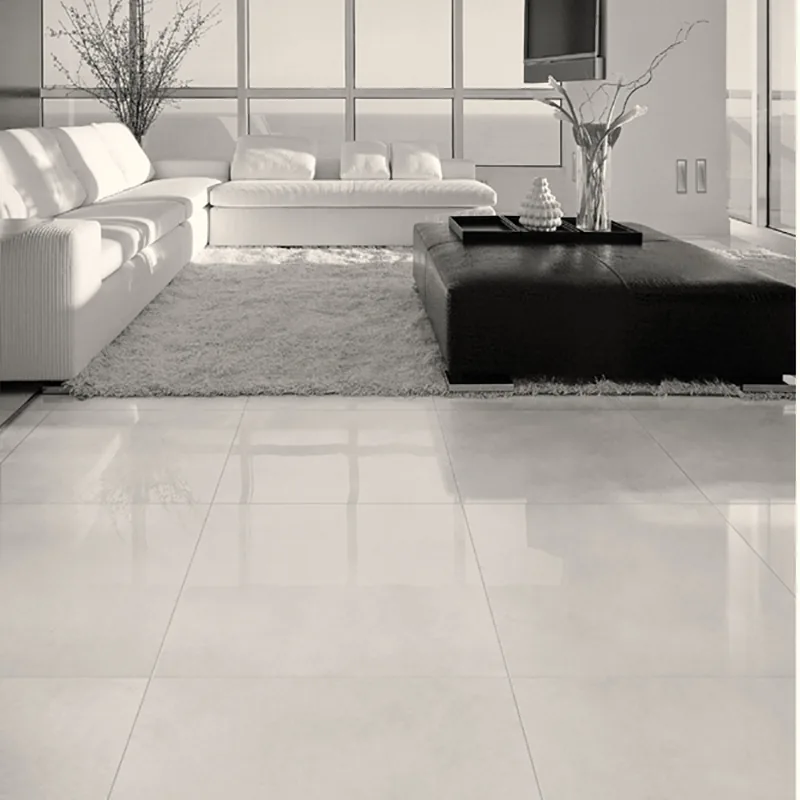
Sealing polished porcelain · Perth
The gloss that keeps smearing.
Polished and lappato porcelain looks flawless in the showroom, then streaks and marks the day it gets lived on. GlassProtect is the one and only next generation sol-gel surface coating in Australia: a clear layer that bonds into the polished face so water, dirt and oily marks can no longer key in, and lift with a quick wipe instead. You are not buying a floor that never needs a mop. You are buying a floor that is genuinely easier to keep clear, and this surface is squarely our sweet spot.
The problem
The polish is what makes it smear.
Porcelain leaves the kiln with a hard, sealed, glassy body. Then, to get that mirror gloss, the surface is mechanically ground and polished flat. That grinding cuts the top of the fired face open and exposes a field of microscopic pits. Those pits are the whole reason a "stain-proof" floor never looks quite clean.
What actually happens
Mop water dries into a haze
Every mop leaves a thin film of water, dirt and detergent residue. On a polished floor it settles into the open micro-pores and dries there, so the surface reads cloudy and streaky in raking light even minutes after you have cleaned it. People mop again, and it comes back.
Where the marks come from
Footprints, oil and grout haze cling
Body oil off bare feet, cooking splatter drifting from the kitchen, and the fine cement haze left from the original tiling all key into those same pits. On matte tile it wipes off. On a polished face it holds, which is why polished porcelain shows every mark.
Why the usual fix fails
A floor sealer sits on top and dulls it
The topical floor sealers sold for this problem lay an organic film over the tile. It hazes the gloss you paid for, scuffs under traffic, and eventually has to be stripped and redone. And a penetrating stone impregnator has nothing to grip on a vitrified face, so it does nothing at all.
The result
Endless cleaning, same tired look
You end up cleaning a floor that was sold as easy-care two or three times as often as you should, and it still never gets back to that showroom look. The problem was never dirt. It was where the dirt can hide.
How it works
It seals the pits the polish opened.
Porcelain is a vitrified, glass-like body, so it carries the same reactive silanol groups glass does. GlassProtect condenses a clear Si-O-Si network onto that face and into the polishing micro-pores, filling the hiding places and lowering the surface energy so contaminants sit loosely on top and lift with a wipe instead of keying in.
Bonds into the surface, not on top
The coating cures as a clear inorganic layer chemically bonded to the vitrified porcelain and keyed into the open micro-pores. It is not a film laid over the gloss that can scuff or peel. There is nothing sitting on top to fail.
Protection where the cleaning happens
The whole battle with a polished floor is fought at the surface: the mop, the traffic, the marks. That is exactly where the coating sits, so water and oily residue roll and lift instead of settling into the pits and drying as a haze.
Clear, so it changes nothing you can see
It is a nano-thin, colourless layer. Same tile, same colour, same gloss. The only thing that changes is that smears and marks lift with a wipe instead of keying in, so the floor holds its finish with a fraction of the mopping.
The real edge
Built for the way a floor gets used.
A floor is not a lab sample. It is mopped, scrubbed, walked on, hit with floor cleaner and, near big windows, baked in Perth sun. Every one of those loads acts at the surface, which is exactly where this coating lives. That is why it holds up where a topical film wears off.
Cleaning & traffic
Survives the mopping
The bonded network is engineered right at the surface, so it keeps working through the scrubbing, mopping and foot traffic that wear a topical floor sealer off. It fades slowly and predictably, and renews with a top-up rather than a strip and re-coat.
Chemical
Stable under floor cleaners
The inorganic backbone does not oxidise and break down the way an organic film does, so it stays stable through the routine alkaline floor cleaners of normal maintenance. More resistant, not immune, but it is designed for cleaning, not just water.
UV
Does not yellow in the sun
Polished floors run right up to the glass in most Perth homes. The coating is inorganic, so it does not yellow or chalk in that sun the way an organic film sealer can. Far more UV-resistant than a film, and clear the whole time.
Oil
Lifts the oily marks, not just water
The marks that ruin the look of polished porcelain are oily: foot oil, cooking splatter, furniture polish. This coating repels the oily film, not only water, so those marks sit on top and wipe away instead of keying into the micro-pores.
Proven, not promised
It keeps beading after the scrubbing.
The real test of a coating on a vitrified surface is not the first mop. It is whether it still sheds water and marks after months of cleaning. GlassProtect is built for exactly that, tested at independent labs, and registered on your job under a 10-year guarantee.
- Still beading at 3,000 scrub cycles. GlassProtect is 3x more durable than the leading brand in comparable cream-cleanser abrasion testing, so it keeps shedding water and marks long after a topical film has worn thin.
- Clear and colourless, so nothing changes. Same tile, same gloss, same colour. The only change is that smears and oily marks wipe away instead of gripping the polished face.
- Independently tested. Evaluated at recognised houses including TÜV Rheinland, SGS and Intertek, and REACH-compliant.
Straight talk
What it does not do.
We would rather tell you the limit up front than have you find it later. This coating is a genuinely good answer for polished porcelain, and here is where it stops.
- It does not make the floor self-cleaning. You still mop it. The difference is that marks lift easily and far less often, and the floor comes back to its finish instead of staying hazy.
- It is not scratch-proof. Grit dragged underfoot can still scratch a polished porcelain face, coating or not. This changes how the surface holds dirt and marks, not how hard it is.
- Grout is a different surface. The cement grout between tiles is porous mineral, not vitrified, so it protects by a different route. We assess it and treat it appropriately rather than pretend one coating does both jobs the same way.
- It is a long-lasting treatment, not a permanent one. It degrades slowly and renews with a top-up rather than a strip. The guarantee is registered for 10 years on the repellency function, and it sits on top of your Australian Consumer Law rights.
Questions
Polished porcelain, answered.
Why does my polished porcelain smear when I mop it?
Polishing grinds the fired face flat and opens microscopic pits in it. Mop water, dirt and oily residue settle into those pits and dry as a cloudy film, so the floor reads streaky even when it is technically clean. A clear coating lowers the surface energy so that residue lifts with a wipe instead of drying into the pits, which is what keeps the haze from setting back in.
Can you actually seal porcelain? I was told it does not need it.
Fired porcelain is dense, so it does not need a stone-style impregnator. But polished and lappato porcelain has that open micro-pore layer from the polishing, and that is what marks and smears. GlassProtect is a clear sol-gel layer that bonds to the vitrified face and into those pits, so it suits this surface very well. It is one of our best-fit jobs.
Will it change the look or the gloss?
No. The coating is a clear nano layer that changes only the surface energy, not the colour or the finish. The floor looks exactly the same. It just lets smears, footprints and marks wipe away instead of drying into a haze.
What is the difference between polished and lappato porcelain here?
Lappato is a semi-polished finish, part matte and part gloss. Both get their look from grinding the fired surface, and both carry the same open micro-pores that trap marks, so the coating suits them the same way. The more polished the finish, the more obviously it shows smears, and the more the coating helps.
Does a sealed floor still need mopping?
Yes, and we would rather be straight about it. The hard part is done: keeping the floor clear goes from re-mopping the same smears two and three times over to a single quick wipe, because marks can no longer key into the polished face. You are not buying a floor that never needs a mop. You are buying a floor that is genuinely easier to keep clear, where marks lift with a wipe instead of setting in as a haze.
Does sealing make it slippery?
The coating is thin and clear and does not lay a film over the surface texture the way a topical floor sealer does. We do not make a slip rating claim in either direction, and we will walk you through it honestly for your particular floor and where it is going.
How long does it last, and what does the guarantee cover?
It is a long-lasting treatment, not a permanent one, and it renews with a top-up rather than a strip. Every Extera job is registered under a 10-year guarantee covering the repellency function performing as described. That sits on top of your Australian Consumer Law rights.
Related surfaces
Keep reading.
Go deeper
The science of sealing polished porcelain
The chemistry, the four resistances with their honest bounds, the head-to-head against film and impregnator sealers, and the test standards. Read the technical version →
Porcelain & ceramic
Glazed porcelain tile
The glazed cousin: a sealed glaze that still fingerprints and streaks. How the coating keeps it wiping clean.
Porcelain & ceramic
Matte / honed porcelain
Matte and honed tile grips mop marks in its texture. Why a clear coating makes it far easier to keep clean.
Porcelain & ceramic
Full-body / technical porcelain
Through-body unglazed porcelain in commercial floors. The honest fit, and where its open surface sets the limit.
Porcelain & ceramic
Sintered stone / porcelain slab
Large-format porcelain slab on benchtops. Fingerprints on matte finishes, and how the coating helps.
The Sealing Library
Find your exact surface
Every common hard surface in WA, by material, matched to how well our coating protects it and why.
Get a quote
Stop mopping the same smears.
We will prepare and seal your polished porcelain with GlassProtect, registered under a 10-year guarantee. Confirmed price before you book.