
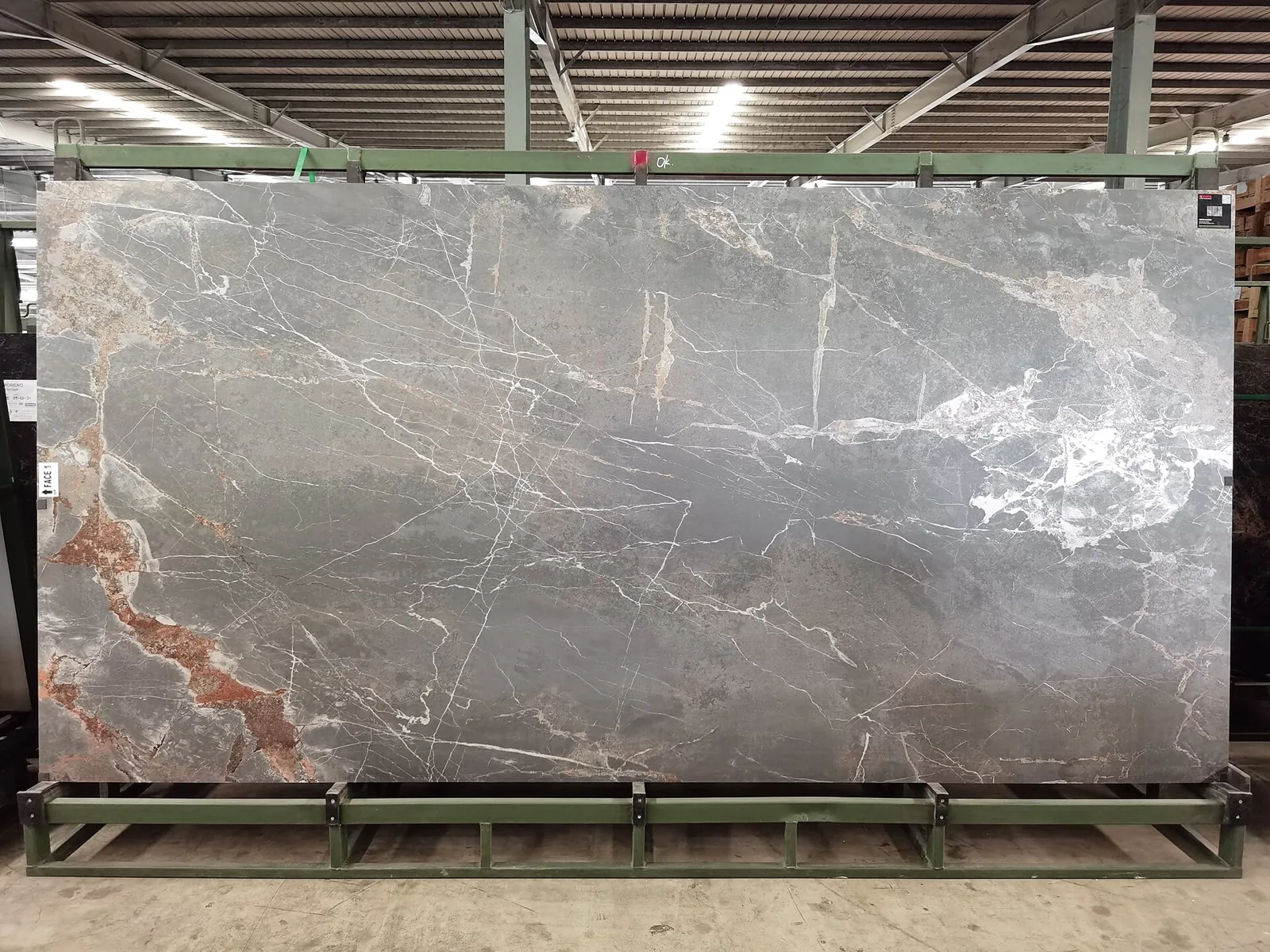
Sealing sintered stone & porcelain slab · Perth
The benchtop that wipes clear.
GlassProtect is the one and only next-generation sol-gel surface protective coating in Australia, and nothing else works like it. On a sintered stone or porcelain slab it does one thing beautifully: it lowers the surface energy so fingerprints, oil and hard-water minerals can no longer bond to the face. They sit loosely on top instead, so a quick wipe clears what would cling to a bare slab. The hard part is done: keeping it clear goes from a cream-cleanser chore to a quick, routine wipe.
The wipe-and-forget promise
Dense doesn't mean it stays clean.
Sintered stone and porcelain slabs are sold as the ultimate benchtop: fired dense, barely porous, heat and scratch tolerant. All true. So why does yours look marked minutes after you wipe it? Because density is the wrong measure for how a benchtop is actually used. What you fight every day isn't liquid soaking in. It's what grips the top of the surface.
The daily one
Fingerprints and smears
Matte, honed and textured finishes are the fashionable choice, and they are the ones that show every touch. The micro-texture that gives the slab its look also holds the oils off your hands, so it smudges the moment anyone leans on it.
Around the tap
Water spots and lime
Perth water is hard. A splash that dries in place leaves the same calcium and mineral ring you get on shower glass, right where the sink and mixer live. It clouds a dark slab and takes real effort to shift.
By the cooktop
The oily film
Cooking oil, splatter and butter leave a greasy film that a plain wipe just moves around. On a benchtop it's oil, not water, that leaves the marks you keep going back over.
Here's the thing your fabricator won't tell you: the slab doesn't need sealing to stop it soaking. It's already dense. What it needs is a lower surface energy, so oil and hard-water minerals can no longer bond to the face and lift in a wipe instead. That is a different job, and it's the one GlassProtect is built for.
How it works
A clear layer, bonded to the surface.
A sintered or porcelain slab is a vitrified surface, close cousin to glass, and our glass chemistry takes to that face well. GlassProtect condenses a clear, invisibly thin sol-gel network onto the slab and lowers its surface energy, so the oil, grease and hard-water minerals that mark a benchtop can no longer bond to it. They sit loosely on the surface and lift in a wipe.
Bonds in, not on
It isn't a film laid over the top that can peel or cloud. GlassProtect forms a clear nano layer chemically bonded to the vitrified surface. There's nothing sitting on top to lift, and it changes nothing you can see: same colour, same finish, same feel.
Oil and water lift in a wipe
By lowering the surface energy it repels oil, not just water. Fingerprint oils, cooking grease and hard-water splashes bead up and lift in a wipe instead of clinging. Less effort, and the slab stays looking clean between cleans.
Renews without stripping
It degrades slowly and predictably through everyday wiping, with no sudden failure point. When it's eventually due, it tops up over itself. There's no film to grind back to bare slab first.
The edge that matters on a benchtop
Built for how a kitchen actually uses it.
A benchtop isn't a display piece. It gets wiped a dozen times a day, splashed with cooking oil, hit with cleaners, and, in an outdoor kitchen, baked in the sun. Protection has to live at the surface, because that's where all of that happens. Here's where the coating earns its keep.
Cleaning & wiping
Survives the daily wipe-down
GlassProtect is a dense inorganic network sitting right at the surface, so it holds up to the cream cleanser, cloths and repeated wiping a benchtop lives through. It's still beading around 100 degrees after 3,000 scrub cycles, where many coatings wipe off within a month. It fades slowly, and renews with a top-up rather than a strip.
Oil & grease
Repels oil, not just water
This is the one most water-only treatments miss, and it's the one that matters most on a benchtop. GlassProtect repels oil as well as water, so cooking grease and fingerprint oils sit on the surface and lift in a wipe instead of smearing and clinging.
Everyday chemistry
Stable under kitchen cleaners
The bonded inorganic surface isn't an organic resin that everyday cleaners break down. It stays stable through the routine detergents a working kitchen throws at it. More resistant, not immune: harsh or strongly acidic products left to dwell are still best kept off any benchtop.
Sun & clarity
Doesn't yellow in the light
On a slab by a big window or in an outdoor kitchen, sun is what ages a coating. GlassProtect is inorganic, so it doesn't yellow or chalk the way an organic film does under UV. It's far more UV-resistant than a film, and it stays optically clear.
Proven, not promised
The test is the scrubbing.
The real test of a benchtop coating isn't a beading photo on day one. It's whether it's still working after a year of cloths, cream cleanser and cooking. That's what we build GlassProtect to survive, and it's what the testing measures.
- Still beading around 100 degrees at 3,000 scrub cycles. Around 3x slower repellency loss than the leading brand in comparable cream-cleanser abrasion testing.
- 3x more durable than the leading brand in the same tests, and optically clear at around 99 percent light transmission, so it changes nothing you can see.
- Independently tested. Verified at recognised houses including TUV Rheinland, SGS, Intertek and under REACH.
Straight talk
Where we tell you straight.
We grade sintered stone and porcelain slab as a strong fit, not our absolute sweet spot, and here's exactly why. This is a genuinely good, dense material. It doesn't need sealing to stop liquid soaking in, because it barely absorbs. So if a salesperson tells you a coating is going to stop your slab from staining through, they're solving a problem you don't have.
What GlassProtect does is different and specific: it fixes the surface. Fewer fingerprints, less water spotting, oil that wipes instead of smears, and a slab that stays looking clean for longer with a lot less effort. That's a real, daily win, and it's honest about its lane.
What it isn't: it doesn't make the slab scratch-proof or heat-proof, and it won't change a factory finish. It's more resistant to everyday chemistry, not immune, so harsh acids or aggressive cleaners left sitting can still mark the surface. And it's a long-lasting treatment, not a permanent one, so it tops up over time. That's a guarantee, backed and registered, not a claim that it lasts forever.
Common questions
Sintered stone, answered.
Does a sintered stone or porcelain slab benchtop even need sealing?
Not for absorption. A sintered slab is dense and takes on very little liquid, so this is not about stopping it soaking through. GlassProtect works on the surface energy instead, so fingerprints, oil films and hard-water minerals can no longer bond to the face. They sit loosely on top and lift in a quick wipe, where on a bare slab they cling.
Will GlassProtect change the look or finish of my slab?
No. It's a clear nano layer, colourless and non-pigmenting. Same colour, same finish, same feel. The only change is that oil and hard-water minerals can no longer bond to the surface, so they lift in a wipe instead of clinging.
Will it stop the fingerprints and smudges on a matte benchtop?
It reduces them a lot. Matte and textured finishes hold the oils from your hands, which is why they smudge. GlassProtect lowers the surface energy so those oils lift in a wipe instead of clinging. It's a big improvement, not a fingerprint-proof surface.
Does a sealed benchtop still need any upkeep?
Yes, and here's the honest version. The hard part is done: GlassProtect turns keeping your benchtop clear from a cream-cleanser chore into a quick wipe, because oil and hard-water minerals can no longer bond to the surface. Constant hard water left to dry with no wiping can still leave spots, on any benchtop on earth. The difference is that on a coated slab those spots sit loosely on top and lift easily, where on a bare one they build into a stubborn mineral ring. You're not buying a benchtop you never have to clean. You're buying one that's far easier to keep clean, where a quick wipe handles what used to take real effort.
Can I put a hot pan straight onto it?
The slab itself is fired at very high temperature and is heat tolerant, and the coating handles the heat of a working kitchen. Even so, we'd give the same advice we give on any benchtop: use a trivet for hot pans. Thermal shock and scratching are about the material and how it's treated, not something a surface coating is there to solve.
How long does it last, and is it guaranteed?
It's a long-lasting treatment, not a permanent one. It degrades slowly and predictably, and it tops up over itself without stripping. Every Extera application is registered under a 10-year guarantee.
Can I keep using my normal kitchen cleaners?
Yes, for routine cleaning. The bonded inorganic surface is stable under the everyday cleaners a kitchen sees. Avoid harsh, highly acidic or strongly abrasive products left to dwell. The coating is more resistant, not immune.
Keep reading
Related surfaces & the science.
Go deeper
The science of sealing a vitrified slab
The full technical read: the sol-gel chemistry, surface energy and sliding angle, the head-to-head against films and impregnators, the test standards and the honest bounds. Go deeper on the science.
Read the technical guideBrowse
The Sealing Library
Every common hard surface in WA, by material, matched to how well our coating protects it. Search your material or browse the families. Where we're not the right answer, it says so.
Find your surfaceGet a quote
Make your benchtop wipe-clean.
We'll prepare and treat your sintered stone or porcelain slab with GlassProtect, registered under a 10-year guarantee. Confirmed price before you book.