
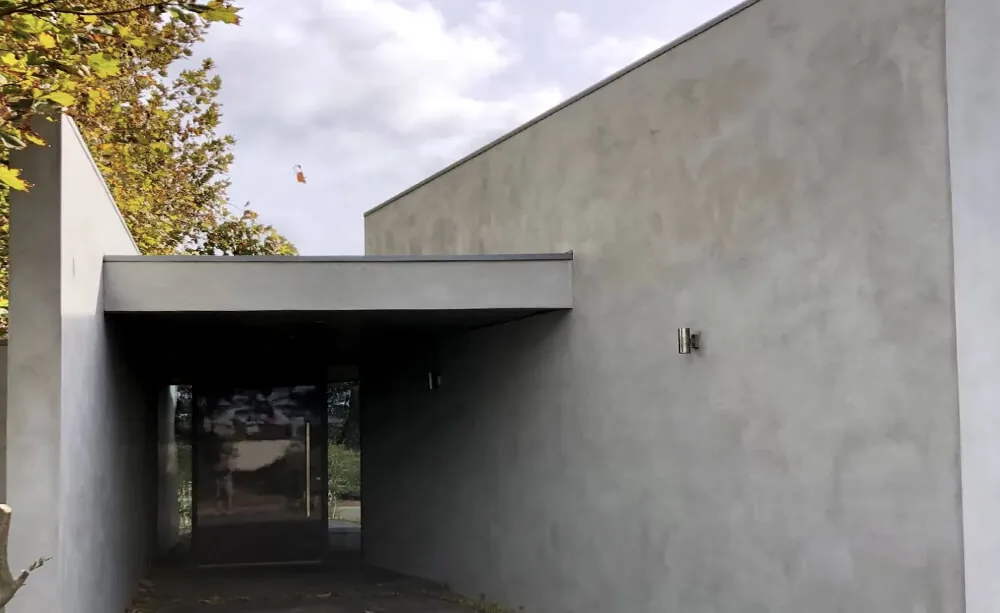
Sealing cement render · Perth
Render that stays the colour you rendered it.
JUMBOGUARD is the one and only next-generation sol-gel surface coating in Australia, and nothing else works like it. On cement render it bonds into the wall itself, so your facade sheds the dirt, the green and the streaking instead of drinking them in, and it does it while the render keeps breathing.
What render is up against
Render is a sponge with a nice finish.
Sand-cement render looks solid, but it is porous and slightly rough, which is exactly what dirt, water and living things want. Left bare it soaks up everything the Perth weather throws at a wall, and within a few years a crisp facade looks tired, patchy and grey. Here is what actually happens, and why the usual fixes make it worse.
The shaded side
Green and black growth
South and east walls, and anything behind a hedge or under the eaves, stay damp longer. Algae and mould feed on the trapped moisture and the dirt caught in the render texture, and the wall goes green then black. You wash it, it comes back by the next wet season.
The white bloom
Efflorescence
Moisture moving through the wall carries salts to the surface, where they dry as a chalky white bloom. It is a sign the render is wet inside and letting water travel through it. Seal that moisture in behind a paint film and it has nowhere to go but into blistering and flaking.
The street side
Dirt, streaks and grime
Rain runs dirt down the wall in streaks. Reticulation over-spray leaves mineral marks. Road film and garden splash settle into the texture. The render does not get dirty evenly, it gets dirty in the ugly patterns that make a house look neglected.
The trap most people fall into: painting or coating the render with a film to hide it. A film on an outside wall is loaded with sun from the front and moisture from behind, so it blushes, peels and can pull the render face off with it. Then it has to be stripped before you can redo it.
How it works on render
It doesn't coat the wall. It bonds into the render.
Cement render is bound by the same Portland-cement paste as concrete, and that paste is rich in the silica chemistry our coating grafts to. So on render this is not a film sitting on top hoping to hang on. It cures into the surface as an inorganic mineral network, right where the weather hits.
Bonds in, not on
MineralProtect is a water-based mineral sol-gel that anchors into the render's own cement chemistry at the surface, curing into a dense Si-O-Si network only nanometres thick. There is no film on top to chalk, peel or lift, because the protection is chemically part of the surface.
Protects at the face, where the weather is
Everything that ruins a rendered wall happens at the surface: the rain, the dirt, the growth, the sun. A pore sealer builds its protection millimetres down, out of reach of all of it. We put ours exactly where the wall is attacked, so it actually meets the weather.
And it still breathes
Because it works at the surface instead of plugging the pores, moisture can still move out of the wall. That is the difference between render that dries and render that traps salt behind a coating and spalls. We protect the face and let the render keep breathing.
Why it lasts on a wall
It survives the things that wear a wall out.
A facade is not a lab sample. It is soft-washed to kill mould, hit with house-wash chemistry, baked under western sun and streaked with road film. Every one of those loads acts at the surface, which is exactly where our coating lives. Here is how it stands up.
Cleaning and soft-washing
Built to survive the wash-down
Rendered walls get soft-washed and pressure rinsed to shift green growth and grime. That cleaning is what wears a coating off. Ours is a dense inorganic network anchored at the surface, so it keeps working through the washing that strips a film, and it fades slowly and renews with a top-up rather than a strip.
Chemical resistance
Stands up to house-wash chemistry
Killing mould on render means alkaline house-wash and chlorine soft-wash mixes. That is the exact chemistry that hydrolyses a pore sealer's anchor bonds and fails it from the inside. Our inorganic backbone is stable to routine cleaning chemistry: more resistant, not immune, and far better matched to how a wall actually gets cleaned.
UV stability
Doesn't yellow or chalk in the sun
A west-facing rendered wall takes brutal UV. Organic films and painted coatings answer that with chalking, and the wrong ones yellow. Our coating is inorganic, so it carries nothing for the sun to break down that way. It is far more UV-resistant than an organic film, and it holds up under the sun that ages other coatings.
Grime and oily film
Road film and airborne grime lift off
Street-facing and garage walls collect traffic film and airborne grime, the oily kind of dirt that a water-repellent-only surface still holds. Because we lower the surface energy of the render, that grime sits on top and lifts in cleaning instead of soaking into the wall, so a wash-down actually gets the wall clean.
Proven, not promised
One clean wall, done once.
The real test of a render coating is not day one. It is whether it is still shedding dirt after a couple of Perth summers and a few wash-downs. Ours is built for exactly that, and it is on the record.
- Stable under alkaline cleaners and pressure washing. The exact conditions that quietly hydrolyse and fail a standard pore sealer, from the inside, with no warning.
- Degrades slowly, not suddenly. No hidden failure point and no stripping to renew. It eases back toward untreated over years and tops up over itself on a clean wall.
- Independently tested. The chemistry behind JUMBOGUARD is tested at independent houses including TUV Rheinland, SGS, Intertek and REACH.
Straight about the limits
What sealing render won't do.
We would rather tell you the boundaries now than have you find them later. Sealing protects the surface of sound render. It does not fix render that has a problem underneath.
It won't fix cracks or drummy render
If the render is cracked, debonding or drummy, that is a substrate repair, not a sealing job. A coating protects a sound wall, it cannot re-stick render that is letting go. We will tell you at the quote if that is what we see.
It's colourless, so it won't hide what's there
Because it changes nothing about how the render looks, it will lock in existing stains and green if you seal over them. That is why we clean the wall back to sound, clean render first, then seal it.
Not waterproof, not permanent
It is a water-repellent surface treatment, not a waterproofing membrane, and it is long-lasting rather than forever. On a very salt-loaded coastal wall we assess the substrate first, because any repellent changes how a wet wall dries.
The questions we actually get
Render sealing, answered.
Will sealing stop my render going green?
It makes it far harder for green to take hold. Algae and mould need dirt, moisture and a rough surface to grip. A sealed render sheds water and grime instead of holding them, so the wall stays cleaner for longer and a soft-wash lifts what does land far more easily. It is not a mould killer and it is not permanent, but it changes how often you are up a ladder washing the wall.
Does it change the colour or finish of my render?
No. MineralProtect is colourless and non-pigmenting. It changes the surface energy of the render, not its look. Same colour, same texture, same matte finish, whether your render is bagged, sponge-finished or trowelled smooth.
Will it stop efflorescence, the white bloom on my wall?
Efflorescence is salts carried out of the wall by moisture. Because our coating leaves the render breathing rather than sealing it up, that moisture can still escape and the process completes at the surface where it wipes off, instead of being trapped behind a film where it lifts and flakes the render. On a very salt-loaded coastal wall we assess the substrate first rather than promise it away.
Can you seal render that has already stained or gone green?
Yes, but we clean it first. The coating is colourless, so it locks in whatever is there. We soft-wash the green and dirt off and let the render dry, then seal a sound, clean surface so it stays that way.
How long does it last, and is it guaranteed?
It is a long-lasting treatment, not a permanent one. It degrades slowly and predictably rather than failing all at once, and when it is eventually due it tops up over itself with no stripping back. Every Extera seal is registered under a 10-year guarantee.
Can I still paint or re-bag over the render later?
Sealing is best done on bare, clean render rather than under a future paint or bag coat, because paint needs an absorbent surface to key into. If you are planning to paint, tell us at the quote and we will tell you straight whether sealing is the right move for your wall or whether a breathable paint system suits you better.
Related surfaces
More from the library.
Cement render sits in our cement-bound family. If your project mixes surfaces, these are the ones people ask about alongside it.
Not sure where your surface fits? Browse the whole Sealing Library and find your exact material.
Get a quote
Seal the render. Keep the wall.
We will clean your render back to sound and seal it with MineralProtect, so your facade stays clean and keeps breathing. Confirmed price before you book, registered under a 10-year guarantee.