
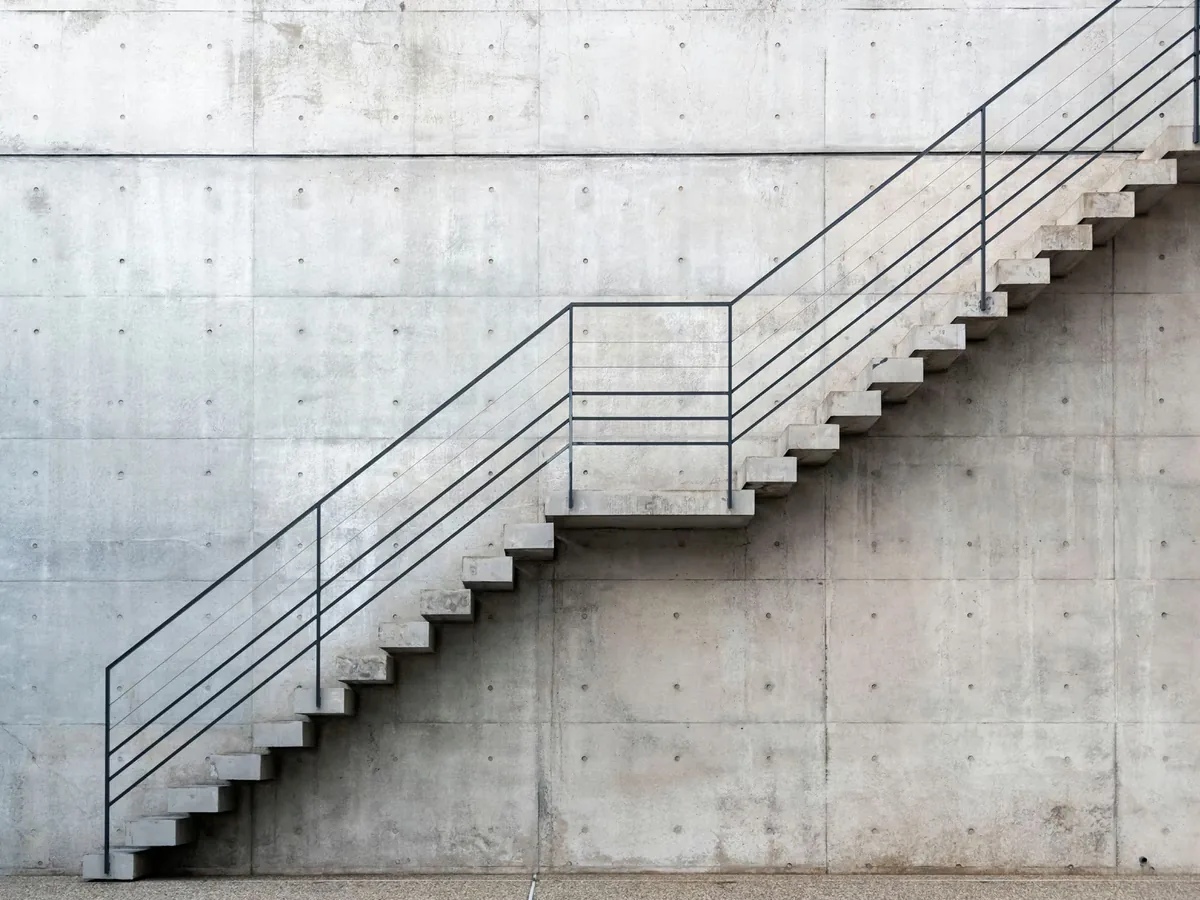
Sealing architectural concrete · Perth
Protect off-form concrete. Change nothing.
Architectural concrete is chosen for exactly how it looks: the raw, matte, board-marked face an architect specified on purpose. Most sealers darken it, gloss it, or peel off it. Ours does not. JUMBOGUARD is the one and only next-generation sol-gel surface coating in Australia, a colourless mineral layer that bonds into the concrete itself and leaves the look untouched while it protects the face.
What goes wrong on a bare concrete face
The look is the whole point. And it fades.
Off-form, board-formed, fair-faced, tilt-up and precast concrete are all porous, and they sit out in the open on a wall or facade with nothing on top. In Perth that means the exact face the building was designed around is the first thing to weather. Here is what we see, and why the sealer most people reach for makes it worse, not better.
Blooms and streaks
White bloom and tide marks
Efflorescence carries salts to the surface as a chalky white haze, and rain running down a vertical panel leaves dark tide marks and streaks. On a raw face there is nothing to slow either, so the panels go patchy long before the building is old.
Grime and growth
Dirt, carbon and green
A porous face grabs atmospheric grime, traffic carbon and, on shaded south walls, organic growth. It soaks in rather than sitting on top, so a wash only lifts part of it and the concrete keeps darkening unevenly.
The wrong fix
A film that ruins the finish
The common answer is an acrylic or urethane coating. On a facade it glosses and darkens the matte face the architect wanted, then under UV it chalks, blushes and peels, and it traps the moisture the concrete needs to release. When it fails it has to be stripped, not topped up.
The trap: the moment you put a film on architectural concrete to protect it, you change the one thing it was specified for. The finish and the protection end up at odds. They should not be.
How our coating works on concrete
It bonds into the surface. And stays invisible.
The category had two ways to seal: lay a film on top, or soak a repellent down into the pores. Both wear out in WA and both compromise the look. JUMBOGUARD is a third way. Concrete carries reactive silica in its cement paste and its quartz aggregate, so our mineral sol-gel bonds into the surface itself, exactly where the weather and the cleaning happen.
Anchors into the surface, not on top
The coating cures into the concrete face as a dense inorganic network, roughly 90 to 100 nanometres thin. There is no film sitting on the surface to chalk, blush or peel, and nothing to strip when it is eventually due for a refresh.
Colourless, so the finish is untouched
It changes the surface energy, not the appearance. Same colour, same matte board-marked texture, same feel. Water and grime stop gripping, but the face still reads exactly as the architect intended.
Breathable, so it will not blister the panel
Because it protects at the surface instead of capping the pores, moisture can still escape and efflorescence can complete rather than being trapped behind the face. A film seals that moisture in, and on a facade that is what drives blistering and spalling from behind.
Where the edge really is
Built for how a facade is actually used.
A wall in service is not a lab sample. It is washed, hit with cleaners, baked under sun and streaked with grime, and every one of those loads acts right at the surface. That is exactly where our coating sits, and exactly where a pore-based sealer does not. This is our biggest wedge, so here is what it means for architectural concrete.
Cleaning and abrasion
Survives the wash-downs
Facades get pressure washed, scrubbed and, where tagging is a risk, cleaned hard and often. Our network sits at the surface as a dense inorganic layer, so it keeps working through the cleaning that wears other sealers off. It fades slowly and predictably, and renews with a top-up rather than a strip. A pore sealer strands its repellency below the wear zone, so the cleaning meets bare concrete.
UV stability
Does not yellow or chalk
A vertical facade takes some of the harshest UV of any surface on the building, and that is what breaks most sealers down first. Our coating is inorganic, with no organic chain for the sun to attack, so it does not yellow or chalk the way an acrylic or urethane film does. It is far more UV-resistant than an organic film. Not UV-proof, but built to hold up where films age.
Chemical resistance
Designed for cleaners, not just water
The bonded inorganic surface stays stable through the alkaline cleaners and atmospheric pollution a facade meets, the same exposure that hydrolyses a pore sealer's anchor bonds and makes it fail from inside. It is more resistant, not immune, so it is not acid-proof or alkali-proof, but it is designed for real maintenance rather than consumed by it.
Grime and run-off
Grime lifts instead of soaking in
With the surface energy lowered, dirt, carbon and oily run-off sit on the face and lift in cleaning rather than soaking into open pores and staining. Rain sheets off more cleanly, so you get less of the streaking and tide-marking that makes a bare panel look tired. The concrete stays closer to the day it was poured.
What you actually get
Sealed once, on the record.
One clear price, the right coating for cement-bound concrete, and a registered guarantee behind it. No film to fail, no look to compromise, no reseal every year to keep the same panel protected.
- Independently tested chemistry. The coating is tested at independent houses including TUV Rheinland, SGS, Intertek and to REACH, so the durability is verified, not just promised.
- Colourless and breathable by design. It protects the surface without darkening it and without trapping the moisture a facade has to release.
- Renews without stripping. When it is eventually due, it tops up over itself on a clean surface. There is no failed film to grind back first.
The honest bit
What it will not do.
Sealing architectural concrete well starts with being straight about the limits. Here is where the line sits.
- It will not hide existing marks. Because it is colourless, it protects the surface as it is. Staining, patchiness or old coating that is already there needs to be dealt with in preparation first, or it stays visible under the seal.
- It will not stop efflorescence forming. That is moisture moving salts out of the concrete, and no coating honestly stops it. What ours does is stay breathable so it does not trap that moisture behind the face the way a film does. On a salt-loaded or heavily reticulated panel we assess it first.
- It is not waterproof or permanent. It is a long-lasting treatment that degrades slowly and needs a top-up over the years. It is more resistant, not immune, and never a barrier that lasts forever.
- It will not change the look, and it should not. If you want the concrete darkened or given a wet-look, that is a different product and not what we do. We keep the face exactly as it is.
Common questions
Architectural concrete, answered.
Will sealing darken or gloss my off-form concrete?
No. Our coating is colourless. It is a mineral layer that bonds into the surface and changes only the surface energy, so the raw board-marked face keeps its colour, its matte finish and its texture. The only difference you will notice is that water and grime no longer grip the way they did.
Can you seal a precast or tilt-up concrete facade?
Yes. Precast, tilt-up and board-formed panels are all cement-bound concrete, which is our sweet spot. The coating bonds into the cement paste and quartz at the surface and leaves the pore network open, so a vertical panel keeps breathing while it sheds water and cleans more easily. We seal facades and feature walls the same way we seal flatwork.
Does the coating stop efflorescence?
It does not stop efflorescence forming, and no coating honestly can, because it is moisture moving salts out of the concrete. What matters is that our coating is breathable, so unlike a film it does not trap that moisture behind the face where it can bloom, bubble or lift the surface. On a panel with a real salt or moisture load we assess it before we quote rather than promise something a coating cannot deliver.
Does it yellow in the Perth sun?
It is inorganic, so it does not yellow or chalk the way an organic film does under UV. A facade takes brutal sun in WA, and that is exactly where an acrylic or urethane film shows its age first. Ours is far more UV-resistant than an organic film. It is not UV-proof and not permanent, but it holds up well where films break down.
Does sealing help with graffiti and general cleaning?
It makes cleaning easier because grime, carbon and oily run-off sit on the surface and lift off rather than soaking into open pores. That gives you a better starting point for washing a facade and removing tags. It is not marketed as an anti-graffiti barrier, but a sealed face releases contamination far more readily than bare porous concrete.
How long does it last, and is it guaranteed?
It lasts for years and degrades slowly and predictably rather than failing all at once, and it renews with a top-up on a clean surface rather than a strip. Every Extera job is registered under a 10-year guarantee covering the coating's repellency function and our workmanship.
Keep reading
Related concrete surfaces.
Exposed aggregate concrete
Washed and seeded driveways and paths, and why a peeling white cure-and-seal is the usual culprit. Read the guide
Plain / broom-finish concrete
Grey brushed and float-finished slabs, and how a colourless seal keeps oil and grime out of an open surface. Read the guide
Coloured / oxide concrete
Charcoal, colour-through and dry-shake finishes, and protecting the colour without a wet-look film. Read the guide
Stamped / decorative concrete
Imprinted and stencilled patterns that came sealed with a film, and the honest way to protect them. Read the guide
Same family
Cement render
Cement and acrylic render on walls and facades. How a breathable coating sheds water without trapping it.
Go deeper on the science
The technical reference for architectural concrete
The chemistry in full: how the sol-gel anchors into the cement paste and quartz, the four resistances with their honest bounds, the head-to-head against impregnators and films, and the test standards behind it. Written for specifiers and the genuinely curious.
Get a quote
Protect the face. Keep the look.
We prepare and seal architectural, off-form and precast concrete with the right JUMBOGUARD coating, colourless and breathable, registered under a 10-year guarantee. Confirmed price before you book.