
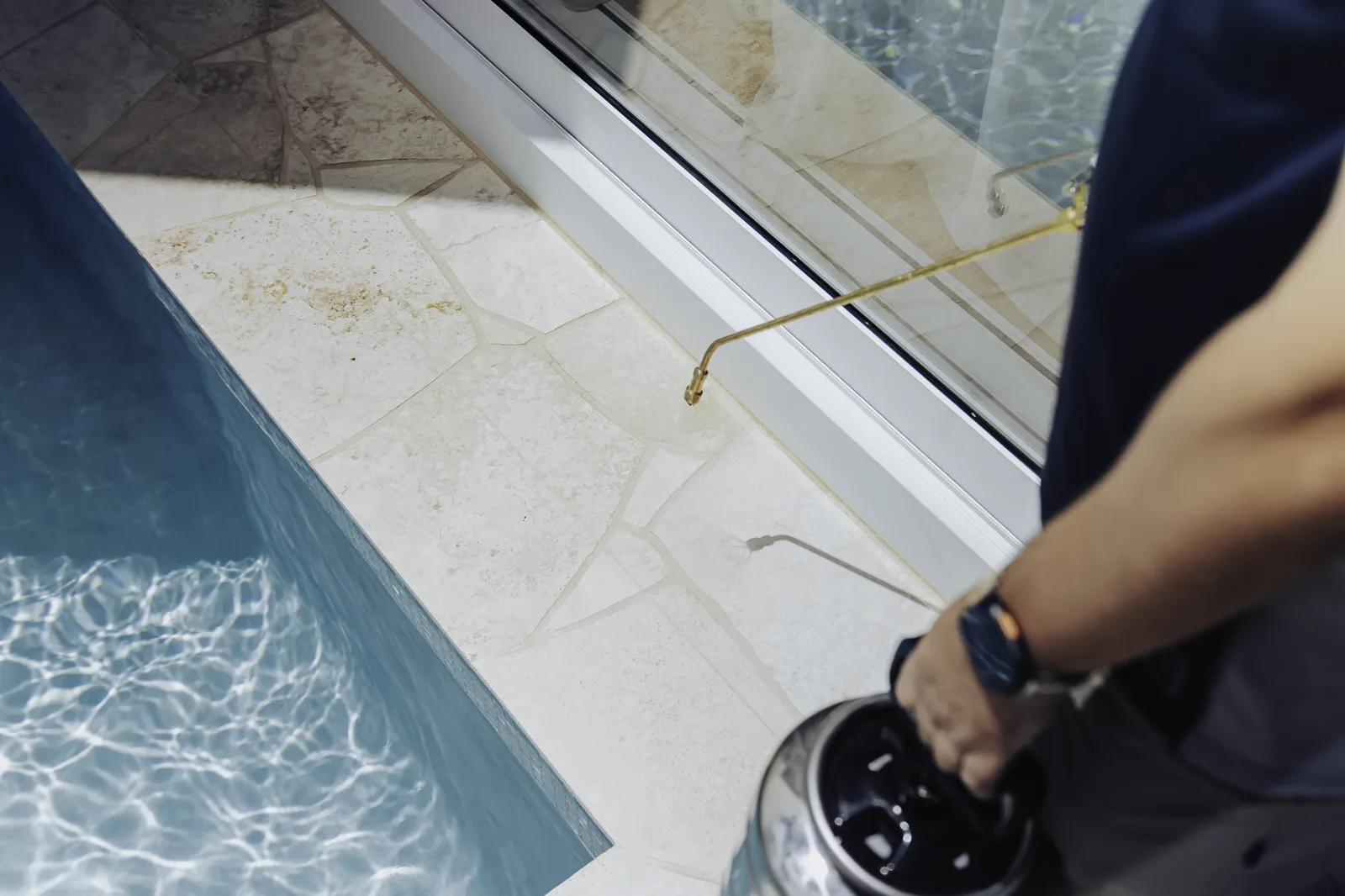
Field notes · Perth · seasonal paving
Why do my pavers go green in winter?
Every year, the same thing. Paving that looked perfect all summer turns green the moment the rain settles in. It is not sudden, and it is not bad luck. It is algae and moss waking up to exactly the conditions a Perth winter hands them: water, shade, and time to sit damp. Here is why winter is when it shows, and what actually keeps it in check.
The short answer
Winter flips all three switches at once.
Green on pavers is a living growth, algae and often moss and lichen, not a stain. Like any plant it needs three things: moisture, shade and a surface to settle on. A Perth summer starves it, because the hot sun bakes the paving bone dry within hours of any water. Winter reverses every part of that. The rain arrives, the low sun leaves your paving in shade for longer, and cool, mild days mean the surface never fully dries between wettings. The growth was always trying to take hold. Winter is simply when the conditions finally let it.
More water
Rain and dew
Regular winter rain, heavy morning dew and slower runoff keep porous paving wet for days at a time. Low spots and poor drainage hold puddles that never quite disappear. Constant damp is the single thing algae needs most.
Less sun
Longer shade
The winter sun sits low and weak, so south-facing paving, shaded courtyards and anywhere under eaves or trees barely sees direct light. Without the sun to dry it out, the surface stays damp far longer than it would in summer.
Mild days
Growing weather
Cool but rarely cold, a Perth winter is comfortable growing weather for algae and moss. Warm enough to grow, wet enough to thrive, and never dry enough to knock it back. That is why it can spread so fast in a few weeks.
The point to hold onto: the green did not appear overnight. Winter just handed a growth that was already waiting the water, shade and time it needed to show up all at once.
Read the pattern
Where it shows tells you what it is.
Before you reach for anything, read where the green is turning up. On a wet, shaded surface it is almost always a living growth, and it behaves in ways that give it away. But not every green on stone is alive, so it is worth a quick check first.
It follows the damp and the shade
Winter green concentrates exactly where the surface stays wettest and darkest: the shaded side of the house, under the tree, along the fence line, around the pool, in the joints and the low spots. If the green maps neatly onto your dampest, most shaded paving, you are looking at algae and moss.
It is slightly slimy, and it can be slippery
A living film feels faintly slimy when wet and turns genuinely slippery underfoot, which matters most around steps, pool edges and entry paths in winter. That slickness is the clearest sign it is a growth, not a mineral mark, and the best reason not to just leave it until spring.
Not all green is the same
One catch worth knowing: some green on stone and brick is not alive at all. If bleach and a scrub do nothing, you may be looking at a mineral reaction coming out of the stone itself, which needs the opposite treatment. We pulled that one apart here: the green that isn't algae
Confirmed it is the living kind? The full, safe, step-by-step on clearing it without wrecking the stone lives here: how to clear green off pavers
Why it keeps coming back
Bare pavers hold water. That is the fuel.
You can clear the green every winter and it returns every winter, because clearing it does nothing about the reason it grows: porous paving that soaks up water and stays damp. Change what the water does on the surface and you pull the fuel out from under it.
On bare paving, winter rain soaks in and lingers
Open pores drink up every drop of rain and dew and hold it. In shade, through a cool winter, the surface barely dries between wettings, so it stays damp for days, spores settle in, and the green spreads across the top and roots down where a hose cannot reach.
A breathable seal sheds the water and lets it dry
Our coating anchors into the mineral surface and stays breathable and colourless. Water beads and sheets off the top instead of soaking in, so the paving dries out far faster after rain. Less standing damp through winter means far less of what algae needs to take hold.
And what does appear sits on top, so it washes off
Because the growth can no longer key deep into open pores, the green that does form sits on a protected surface. It lifts with a wash instead of a dwell-and-scrub battle. You get green slower, lighter and far easier to clear, even in the middle of winter.
The honest limit
No seal makes green impossible.
We will say it straight, because plenty will not. Algae is airborne and it will land on any surface that stays wet and shaded long enough, coated or not. A seal does not sterilise your paving or bring back the sun, so a spot in deep, constant winter shade with a downpipe emptying onto it can still go green over time. What the seal changes is the odds and the effort. The surface dries faster, the growth cannot root deep, and it comes back slower, lighter and washes off far more easily than off raw stone. You are not buying paving that can never green up. You are buying paving where winter is an occasional wash instead of an annual battle, and where fixing the shade and the drainage alongside it does most of the work. It also pays to seal before the wet season, not during it, so the coating goes onto dry, clean paving, which is the whole point of our stone and paving service.
What to do next
Clear it, then seal it so next winter is easier.
The order matters. A seal protects clean, dry paving, it does not cure a green surface. Get the growth off and the pavers dried out first, then lock that in with a breathable coating so next winter has far less to feed on and lifts with a wash.
- Clear the green first, gently, with the right cleaner for the growth and the stone, then let it dry out.
- Fix the water and the shade, so you are not sealing over the same damp that caused it.
- Then seal it, with a breathable coating that sheds water and anchors into the surface, under a 10-year guarantee.