
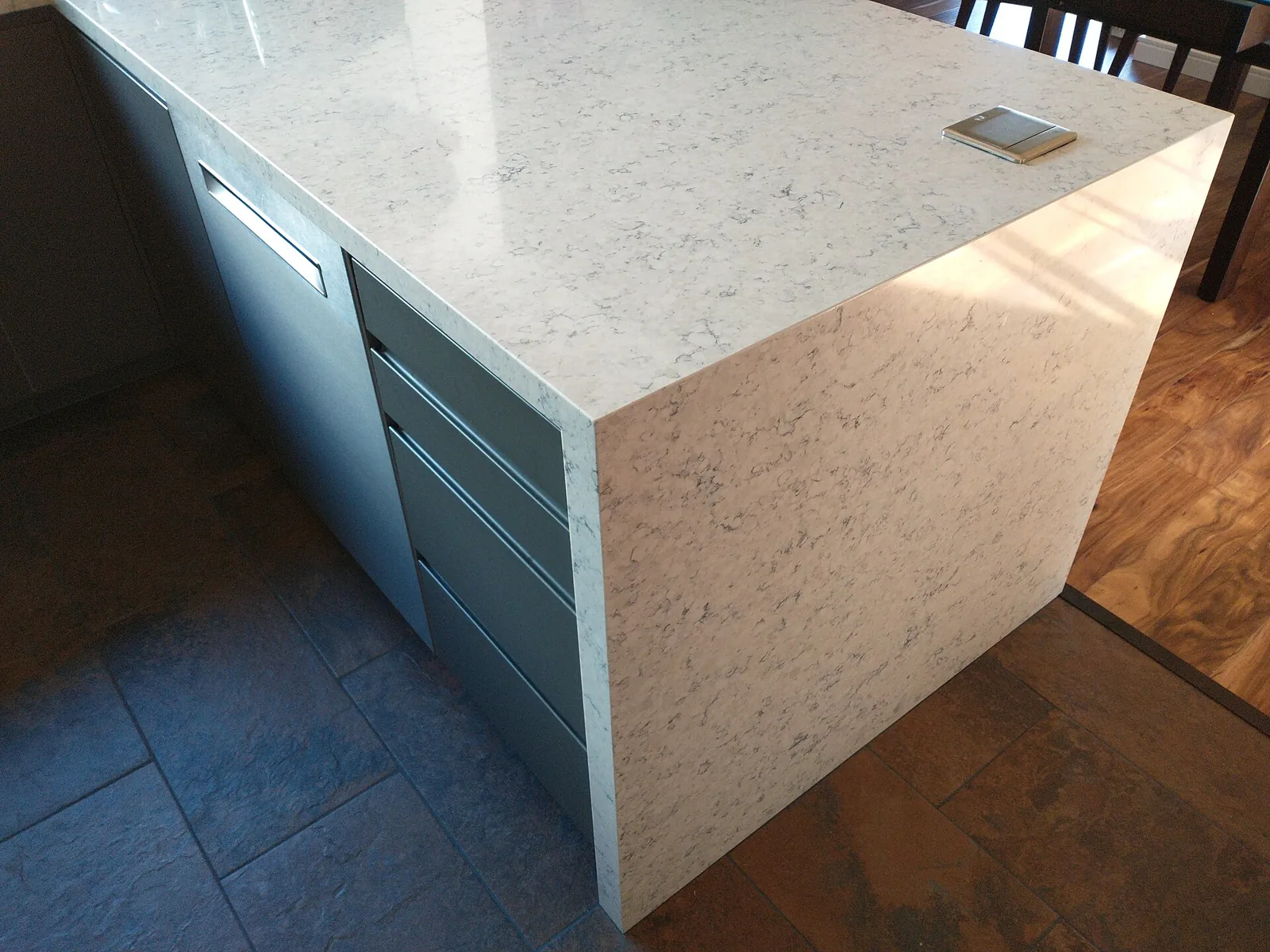
Sealing engineered quartz · Perth
The benchtop we tell you not to seal.
We make the one and only next-generation sol-gel surface coating in Australia, and nothing else works like it. Engineered quartz, the Caesarstone-style benchtop, is one of the few surfaces where our honest answer is: you do not need it. Here is exactly why, and what actually protects it.
What engineered quartz actually is
A benchtop that comes pre-sealed.
Most people find us because they have been told every stone benchtop needs sealing. With engineered quartz, that advice is simply wrong, and we would rather tell you than take your money. Engineered quartz is not quarried stone. It is roughly nine parts crushed quartz to one part polymer resin, mixed with pigment and pressed into a slab. That resin fills the gaps between the grains, so the finished surface behaves nothing like natural limestone or travertine.
It does not soak up
Non-porous by design
The resin binder seals the surface as the slab is made. Water, wine and oil sit on top and wipe off rather than soaking in and staining, which is the whole reason porous stone gets sealed in the first place. Engineered quartz does not have that problem to solve.
The makers say so
Never needs sealing
This is the rare case where the manufacturer and the sealer both agree. The brands that make these benchtops state plainly that they never need sealing, and some warn that a coating can even cloud the finish. We are not going to argue with the people who built it.
Its limits are the resin
Heat and harsh chemicals
The one weak spot is that same resin. A hot pan straight off the stove can scorch it, and strong solvents can dull it. Those are real limits, but no thin coating changes them, so sealing does not fix the one thing engineered quartz is actually vulnerable to.
The confusion worth clearing up: engineered quartz is not quartzite. Quartzite is a natural, quarried, porous stone and one of our best surfaces to seal. Engineered quartz is a manufactured resin composite. The names are one letter apart and the care is opposite, so it is worth knowing which one is on your bench before anyone quotes you to seal it.
How our coating works
Our coating needs something to grip.
For decades there were only two ways to seal a surface: lay a film on top, or soak a sealer into the pores. Both wear out. Our coating is a third way, a mineral sol-gel that anchors into the surface itself, so it protects right where wear and cleaning happen. But that mechanism has a requirement, and engineered quartz does not meet it.
It anchors into the surface
On a siliceous, porous stone the coating cures into a dense inorganic network that anchors into the mineral, colourless and breathable. That open structure is what gives it something to hold, and what makes it last for years where ordinary sealers fail.
Engineered quartz gives it almost nothing to hold
The resin binder has already filled the pore structure, so there is no open network to anchor into. A large part of the surface you touch is that resin rather than open mineral, so even the chemistry has little to grip. The coating would have almost nothing to bond to and, more to the point, almost nothing to protect.
So we do not pretend otherwise
Naming where a product does not fit is the most useful thing we can tell you. On engineered quartz, our coating is a solution looking for a problem the benchtop was built without.
The honest comparison
Everything a sealer defends against, engineered quartz already handles.
Our biggest edge on the surfaces we do seal is real-world resistance: cleaning, chemicals, sun and oil, all met right at the surface. Run engineered quartz through the same four tests and you can see why it does not need us, and where its real weak spot sits.
Oil and staining
Nowhere to soak in
On porous stone we shed oil and grease so a benchtop spill lifts in cleaning instead of setting. Engineered quartz is already non-porous, so oil, wine and food sit on top and wipe away on their own. It reaches the same outcome the resin built in, without a coating.
Cleaning and abrasion
Wipes clean already
The easy-clean surface we engineer onto porous stone is the surface engineered quartz ships with. A mild cleaner and a cloth is all it asks. Where we would earn our keep on a rough, open stone, this benchtop simply does not have the problem.
Chemical
The resin is the limit
Here is the honest weak spot. Strong solvents and harsh chemicals can dull or mark the resin binder, and no sealer stops that, in the same way no sealer stops acid etching carbonate stone. The fix is to keep those chemicals off the bench, not to add a coating that cannot survive them either.
Sun and heat
A kitchen, not a courtyard
Our inorganic coating earns its keep outdoors, where UV chews through ordinary film sealers. Engineered quartz is an indoor benchtop and is not made for the sun, and its real heat risk is a hot pan on the resin, which a trivet solves and a coating does not.
The straight version
What we would tell you on the phone.
The operators who tell you every surface needs their product are the ones to be wary of. Here is the honest bottom line on engineered quartz, and where we genuinely are the right call.
- Do not pay to seal it. Engineered quartz is non-porous and stain-resistant by design. A coating would sit on a surface built not to need one, and on some finishes it can even cloud the look.
- Care for it simply. A mild cleaner, a trivet under hot pans, and harsh solvents kept off the bench. That is the whole routine, and it is free, so we would rather you keep the money.
- Bring us the surface that does need it. Natural granite and quartzite benchtops are our sweet spot, and travertine, limestone and sandstone around the home anchor well too. Porcelain and sintered stone suit our glass-class coating. That is where sealing earns its place.
Engineered quartz questions
The things people actually ask us.
Does engineered quartz like Caesarstone need sealing?
No. Engineered quartz is ground quartz bound in a polymer resin that fills the gaps between the grains, so the finished slab is non-porous. Liquids sit on top and wipe away rather than soaking in, which is the whole reason porous stone gets sealed. The makers of these benchtops say plainly that they never need sealing, and we agree.
Is engineered quartz the same as quartzite?
No, and it is the confusion we untangle most. Quartzite is a natural siliceous stone, quarried in one piece, porous, and one of our sweet spots for sealing. Engineered quartz, sold under names like Caesarstone and Silestone, is a manufactured product: crushed quartz mixed with resin and pigment and pressed into slabs. They look similar and sound similar, but they are different materials that call for completely different care.
Why will your coating not bond to engineered quartz?
Our coating anchors into a mineral surface. Engineered quartz has almost no open pore structure because the resin fills it, and a large part of the surface you touch is that resin rather than open mineral. So there is very little for the coating to anchor into and, just as importantly, very little that needs the protection.
Will a coating make my quartz benchtop heat or scratch proof?
No. The real limits of engineered quartz come from the resin that binds it: it can scorch or discolour under a hot pan and it can be marked by harsh solvents. No thin coating changes that, and we will not pretend one does. Use a trivet and mild cleaners and the surface looks after itself for the things it is good at.
My quartz benchtop has a dull patch or a stain. Can you fix it with a seal?
Not with a sealer. Dull patches, heat marks and set-in stains on engineered quartz are usually resin damage or a build-up of residue, which a coating cannot undo. The right first step is a proper clean and, for heat or chemical damage, a benchtop repair specialist. Send us a photo and we will tell you honestly whether it is a cleaning job or a repair job.
What benchtop should I seal instead?
Natural stone benchtops are where sealing earns its place. Granite and quartzite are siliceous and porous enough for our coating to anchor into and genuinely benefit from, and they are our sweet spot for stone. If your kitchen is porcelain or sintered stone, our glass-class coating suits those too. Send us a photo and we will tell you straight which of your surfaces are worth sealing.
Keep reading
Surfaces we do seal.
If you are pricing up a kitchen or a bit of tiling, these are the surfaces where our coating earns its place. Porcelain and sintered stone are the usual engineered-quartz alternatives, and each takes our glass-class coating well.
Get a quote
Got a surface that actually needs it?
We will prepare and seal it with the right coating for the material, registered under a 10-year guarantee, at $16/m² all-in. And if it does not need sealing, like your engineered quartz, we will tell you that too.