
Sealing polished concrete · Perth
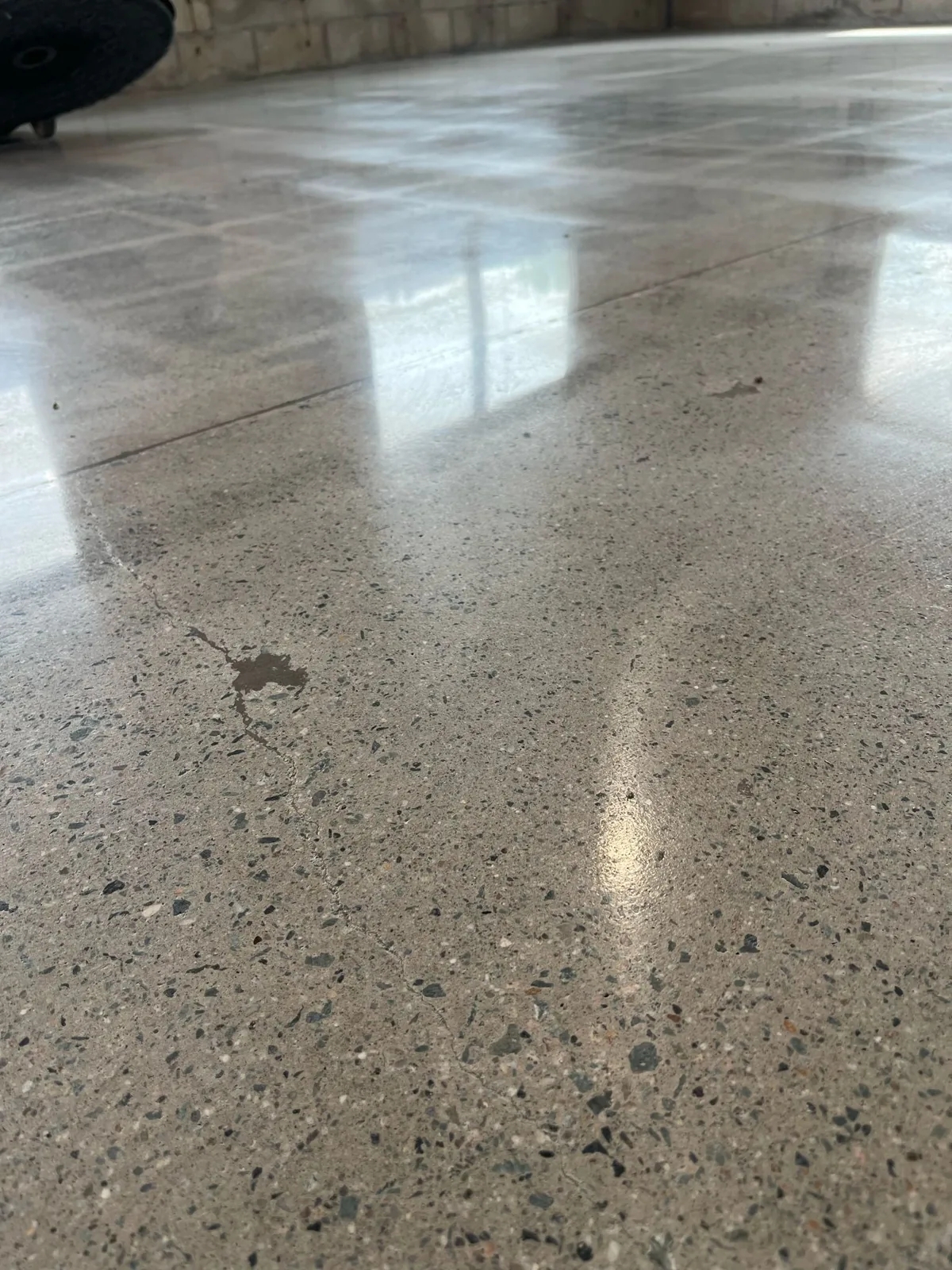
Your polished floor looks sealed. It isn't.
MineralProtect is the one and only next-generation sol-gel surface coating in Australia, and on a mechanically polished concrete floor it does the one thing the polish and the densifier can't: it bonds into the concrete surface itself, so oil, wine and everyday traffic lift away in cleaning instead of soaking in. Colourless, breathable, and this is exactly the surface it was built for.
Polished is not sealed
The shine is hardness. Not protection.
A polished concrete floor is ground back and treated with a densifier that hardens the cement paste until it takes a sheen. It looks like glass. But hardness and repellency are two different things, and the polishing that gives you the look does almost nothing for the stains. So the floor that photographs perfectly is the one that still drinks in a dropped glass of red.
The look that lies
A densifier hardens, it doesn't repel
Lithium and sodium silicate densifiers react inside the cement to firm it up and lift the gloss. Useful for abrasion, but the surface stays open. Oil, wine, coffee and cooking splatter still soak straight into it, and once they are in, they mark the concrete for good.
The coat that scuffs
A guard coat sits on top and hazes
The other common answer is a topical guard: an acrylic or urethane film laid over the polish. It looks protective on day one, then foot traffic scuffs it, chair castors trail it, and it hazes and wears in the walking lanes. When it fails, it can't be spot-fixed. It has to be buffed back or recoated.
The bill that repeats
And it's the floor you live on
This is a kitchen, a hallway, an open-plan living slab: the busiest floor in the house or the fit-out. It cops the mop, the grit under shoes, the sunscreen, the spilled wine and the northern sun through the glazing, every day. A finish that fades in the traffic lanes is a finish you pay to redo.
How it actually protects
It doesn't sit on the floor. It bonds in.
The category had two ways to treat a floor: lay a film on top, or leave the surface hard but open. MineralProtect is a third. It is a water-based mineral sol-gel that cures into the concrete surface as a dense inorganic Si to O to Si network, the same class of bond that holds glass and quartz together. Polished concrete is cement paste and quartz aggregate, both rich in the surface hydroxyls this chemistry grafts to, so on this floor it forms a genuine bond into the surface itself.
Bonds in, not on
It cures into the surface as a nano-thin network, chemically integrated with the concrete, not a film sitting on the polish waiting to scuff or a coat that has to be stripped. There is nothing on top to fail.
Colourless, keeps the sheen
It is non-pigmenting and changes only the surface energy, not the appearance. Same colour, same finish, same level of gloss you paid a polisher to achieve. The only change is that water and oil no longer grip.
Protects where the wear is
The protection sits at the surface, exactly where the mop, the foot traffic, the spill and the sun act. It stays breathable, so the slab still releases moisture and won't be whitened from beneath the way a sealing film can.
The real-world edge
A floor isn't a lab coupon. It's used.
Every load a floor takes acts at the surface: the mop, the grit under shoes, the cleaner, the sun, the spill. That's the one place MineralProtect lives, and it's exactly where a densified-but-open floor has nothing. Four resistances, tuned to how you actually use a polished slab.
01 · Cleaning and traffic
Survives the mop and the walking lanes
The load-bearing network is engineered right at the surface, where scrubbing, damp-mopping, grit and foot traffic act. Its durability comes from network density, not a hardness gimmick, so it wears slowly and predictably rather than hazing off in the lanes. When it is finally due, it tops up over itself. No buffing back, no strip.
02 · Oil, wine and grease
The stains that soak into open concrete
Kitchen oil, olive oil, red wine and coffee are the marks that ruin a polished floor, and a densifier does nothing to stop them. With MineralProtect, oil and grease sit on the surface and lift in cleaning instead of soaking in, so a wiped-up spill wipes away rather than setting into the concrete. And it does it PFAS-free by design.
03 · Cleaners and chemistry
Built for cleaning, not just water
The bonded network is inorganic, so it isn't consumed by the routine detergents and mopping a real floor gets, the same exposure that breaks a pore sealer down from the inside. It is more resistant, not immune: strong acids like undiluted vinegar or citrus cleaners still attack cement itself, so keep those off it. For everyday cleaning, it holds.
04 · The sun stripe
The band of light across the floor
Perth glazing throws a hard stripe of sun across an internal floor, and that is where an organic guard coat yellows and chalks first. MineralProtect is inorganic, so it doesn't have the polymer chain that UV cleaves. It holds up far better under that light than a film does. Far more UV-stable, though never UV-proof.
One price, one standard
Cleaned, sealed and registered.
We don't seal a floor over a weak or dirty surface and hope. The polish is prepped so the coating bonds to sound concrete, MineralProtect goes on to spec by a certified applicator, and the job is registered. One published rate, no surprises.
- Full preparation, always included. The clean is part of the seal, never itemised or sold on its own. The bond is only as good as the surface under it.
- Colourless by design. No darkening, no gloss shift, no wet-look. The floor you polished is the floor you keep.
- Registered under a 10-year guarantee. Documented to your job and backed by the JUMBOGUARD Performance Guarantee, on top of your rights under Australian Consumer Law.
Straight about the limits
What it won't do
The operators who promise stain-proof and permanent are the ones to be wary of. Here is the honest edge of what sealing a polished floor can and can't do.
It is not stain-proof
A spill left to sit overnight can still leave a mark. What changes is that liquids sit on the surface and wipe up instead of soaking straight in, so you have time on your side and cleaning is far easier. You still wipe up spills.
It doesn't stop acid etching
Cement reacts to strong acids. Undiluted vinegar, citrus cleaners or an acidic spill left to dwell can etch the surface itself, and no penetrating sealer stops that, because etching is the acid dissolving the concrete, not a stain sitting on it. Sealing slows absorption and buys you wipe-up time. It doesn't make cement acid-proof.
The beading fades before the protection
The visible water beading is the first thing to ease off, well before the bonded layer stops working. So if water stops beading, that is a prompt to have us re-test, not proof it has failed. It is a long-lasting treatment, not a permanent one, and it tops up without stripping.
The real questions
Polished concrete, answered.
My polished concrete already looks sealed. Isn't the shine the protection?
No. The shine comes from grinding and a densifier that hardens the cement paste. Hardness resists scuffing, but it does nothing to stop oil, wine or coffee soaking into the surface. That is why polished floors that look flawless still stain. Sealing changes how the surface handles liquids, which polishing on its own does not.
Will sealing change the look or the sheen?
No. MineralProtect is colourless and non-pigmenting: a nano-thin layer that changes only the surface energy, not the appearance. The colour, the finish and the level of gloss stay exactly as they are. The only difference you notice is that water and oil stop gripping the surface.
Will red wine or cooking oil still stain a sealed floor?
Nothing is stain-proof, and a spill left overnight can still mark. What changes is the behaviour: oil and grease sit on the surface and lift in cleaning instead of soaking straight in, so a wiped-up spill wipes away rather than setting into the concrete. You clean less often, and it comes clean far more easily.
How is this different from the densifier or the guard coat the polisher used?
A densifier hardens the cement but repels nothing. A topical guard sits on top as a film, which scuffs, hazes and eventually has to be buffed or recoated. MineralProtect is neither: it bonds into the concrete surface itself as an inorganic network, so there is no film to scuff and no coat to strip when it is time to renew.
Will it make the floor slippery?
It is a nano-thin bonded layer, not a coating that builds up on top, so it doesn't add the slick film a topical guard can. It changes how the surface sheds water and oil, not the texture of the polish underneath. We assess your floor and finish at the quote and tell you straight.
How do I clean it, and does it need topping up?
Clean it as you would any polished floor: a damp mop and a neutral or mild cleaner. Keep strong acids like undiluted vinegar or citrus off it. It is long-lasting, not permanent, so it wears slowly and predictably and tops up over itself with no stripping when it is due. Every job is registered under a 10-year guarantee, and we track when yours is due.
Keep reading
More on concrete.
The science
Go deeper on the mechanism
The full technical version: the sol-gel chemistry on cement and quartz, the four resistances with their honest bounds, the head-to-head against densifiers, guards and impregnators, and the test standards behind it.
Closest cousin
Honed and grind-and-seal concrete
The ground, satin-finish relative of a polished floor, often run through the alfresco. Same chemistry, same wine-and-oil problem, a slightly different finish.
Get a quote
Seal the polish. Keep the look.
We'll prepare and seal your polished concrete with MineralProtect, colourless and to spec, registered under a 10-year guarantee. Confirmed price before you book.