
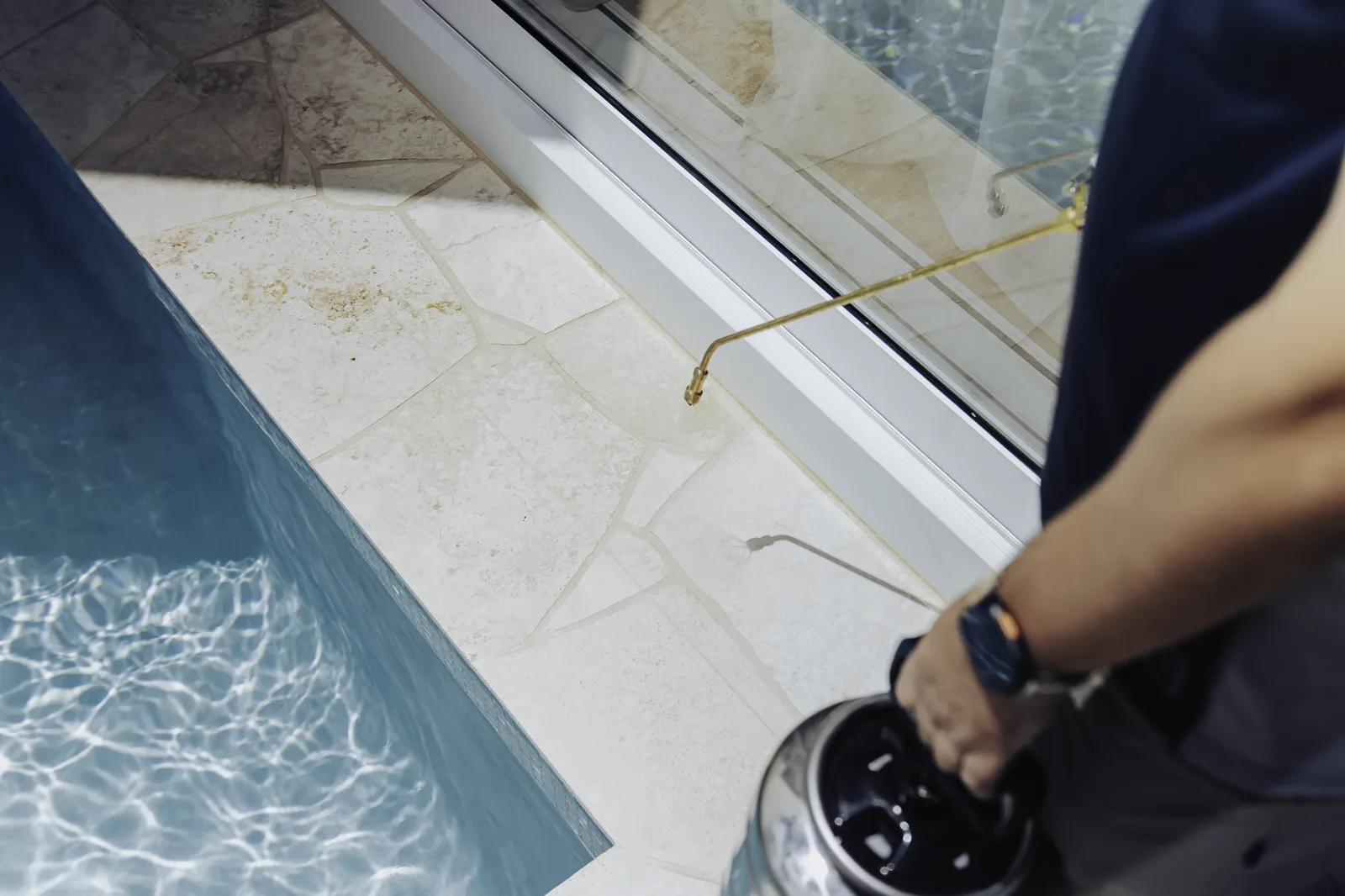
Technical · sealing honed & tumbled marble
The science of sealing marble.
The specifier's version. What the coating is, how it anchors into a calcareous stone that has no covalent partner for silicon, why the honed and tumbled texture is the thing that makes it work, and where the honest limit sits. It is the one and only next-generation sol-gel surface coating in Australia, and it earns that by being straight about the chemistry.
The coating, in short
What we put on the stone.
The carbonate question
Marble has no silicon to bond to.
Here is the honest chemistry, stated plainly. Pure calcite, the calcium carbonate that marble is made of, has no surface silanol groups. So there is no covalent Si-O-Si bond from the coating to the stone the way there is on granite, quartzite, sandstone, glass or concrete. We will not pretend otherwise. What matters is that a covalent bond to every grain is not how a surface repellent anchors on a porous carbonate, and it is not what makes it work.
Mechanical interlock into the pore structure
The water-based sol wicks into the open surface of honed and tumbled marble and condenses in place into a rigid three-dimensional network keyed into pore mouths and grain contacts. This is the dominant anchor on porous carbonate, and higher porosity improves it. It is the exact inverse of dense polished marble, whose near-zero porosity is much of why it is the hard case.
A self-condensed cohesive network
The sol's own silanols cross-link into a silica-like solid. Genuine Si-O-Si bonds do form here, within the coating itself. What is absent is the bond to the calcite, not the bond inside the network, so the coating has real cohesion independent of the stone's chemistry.
Hydrogen bonding to the surface
A contributing anchor, never the primary one, to the adsorbed surface-water film and the under-coordinated hydroxyl and step-defect sites the carbonate carries in Perth's coastal and reticulated conditions.
The regime that gets misquoted: the conservation finding that silicon esters bond poorly to marble is a deep-consolidation result, re-cementing loose grains through roughly twenty-five millimetres to carry structural load. That is a far harder ask than a hundred-nanometre surface repellent, and the same studies still show the treatment raising water contact angle and cutting absorption on limestone even where the calcite bond is weak. Repellency is a surface-energy effect, decoupled from grain-to-grain cohesion. The wording stays honest and precise: it anchors into the mineral, and we claim nothing more than that. For the two mineral families and how each takes a coating, go deeper in stone and sealer chemistry.
The shared science, in brief
Two parts of this are the same on every surface.
The real-world resistance and the head-to-head against the old ways play out the same way on any material we seal, so we cover them in full in the pillars and keep only the marble-specific point here.
The four resistances. Protection lives at the surface, where cleaning, chemicals, UV and oil all land, and every one has an honest bound: more resistant, not immune, and never acid-proof. On marble the resistance that earns its keep is oil, the mark a plain water-repellent seal does nothing about. Here oil beads on the surface and lifts in cleaning rather than soaking in, genuinely oleophobic and delivered PFAS-free by design. The full four, with the bounds and the test standards, are in the four real-world resistances.
Against the two old ways. Every marble seal you have been offered is either an impregnator buried in the pores, which WA sun, alkaline cleaners and traffic hydrolyse from the inside out and which repels water only, or a film on top, the worst option on honed marble because it dulls the look, traps vapour and has to be stripped back to bare stone to redo. Ours is the third class: it anchors at the surface, where the wear and cleaning happen, and tops up on clean stone with no strip. The mechanism, side by side across every class of sealer, is in sealer types compared.
The limit, stated flat
No penetrating sealer stops acid etching.
Marble is calcareous, calcium carbonate. Acid etching is the reaction of carbonate with acid, a dissolution that physically removes material and leaves a dull micro-crater. It is not a stain, and it is correctable only by mechanical re-honing, never by cleaning. Because the acid reacts at the exposed surface and needs no pore penetration to do it, a penetrating sealer cannot prevent it. Sealing slows how fast liquids absorb and buys wipe-up time, which is real and worth having, but for an acid spill the answer is still a fast wipe.
This is the single most important thing to understand about marble, and it is why we grade it a moderate fit rather than a sweet spot, and why we will not sell it as stain-proof or permanent. At the quote we identify which of your specific surfaces are acid-sensitive so you know where a splash still needs attention. For the record: the one surface where we do make an etch-prevention claim is glass, a genuinely different mechanism, and it does not transfer to stone.
- Not permanent, not waterproof, not maintenance-free. A long-lasting treatment that degrades slowly and predictably and is renewed periodically.
- Dense polished marble is the genuinely weak case. Near-zero porosity and no silanols mean little to anchor into. That is honed and tumbled marble's opposite, and it has its own honest page.
- Beading fades before protection does. Contact angle reads only the top nanometre and is the fast clock, so its loss is a prompt to re-test the repellency function, not proof it has failed. The two clocks, in full, are in living with a sealed surface.
Specifier questions
The technical answers.
If there is no covalent bond to the calcite, what holds it on?
Mechanical interlock into the pore structure, a self-condensed silica-like network with genuine Si-O-Si bonds inside the coating, and hydrogen bonding to the surface. On porous honed and tumbled marble the interlock is the dominant, load-bearing anchor, and it improves with porosity. The missing piece is only the covalent bond to the carbonate itself, which is not how a surface repellent grips a porous stone.
Why is honed or tumbled marble a moderate fit but polished marble is not?
Porosity. Honed and tumbled finishes retain open surface texture for the coating to key into and set as a rigid network. A dense polished slab has close to zero porosity and no silanols, so there is little to anchor into. Both still etch in acid, but the anchoring difference is why one seals well and the other is a surface we are honest about not pushing a seal on.
How is the durability measured?
By contact-angle retention across recognised wet-scrub and abrasion cycles, methods in the class of ISO 11998 and ASTM D2486. The coating degrades by slow nano-abrasion rather than a cliff-edge failure, and the material has been tested at independent houses including TÜV Rheinland, SGS and Intertek. We do not publish an invented service-life figure for the product on marble; the guarantee covers the repellency function for 10 years.
What is the chemical resistance, exactly?
The Si-O-Si network is stable across roughly pH 1 to 11 at routine cleaning concentrations and short contact times. Silica hydrolyses above about pH 8 and dissolves above about pH 11, so the honest framing is more resistant, not immune, and never alkali-proof or acid-proof. Acid etching of the marble itself is a separate mechanism that no sealing prevents.
Is it really PFAS-free, and does that cost oil performance?
It is PFAS-free by design, not by reformulating a fluorochemistry out, and it is genuinely oleophobic: the oil contact angle sits around 101 degrees, so oil and grease bead on the surface and lift in cleaning instead of soaking in. The honest bound is that fluoropolymers still gave the lowest surface energy and the strongest oil repellency, so this resists oil staining rather than being oil-proof and does not match fluoropolymer-grade oleophobicity. On a stone where the alternative water-only seals do nothing about oil at all, that is a real gain.
Go deeper
The science behind the specifics.
This page carries the marble-specific delta: the carbonate anchor and the acid-etch limit. For the shared science it rests on, go deeper into the pillars.
Pillar · chemistry
Stone and sealer chemistry
Siliceous versus carbonate, and why the mineral family of a stone decides how a coating holds. Go deeper
Pillar · resistance
The four real-world resistances
Cleaning, chemical, UV and oil, each with its honest bound, and why the surface beats the pore. Go deeper
Pillar · living with it
Living with a sealed surface
The two clocks, why the beading fades first, and how a top-up renews without a strip. Go deeper
This surface
Honed marble, plain-English
The same case without the chemistry: what sealing marble does for you, and where a splash still needs a wipe. Read the guide
The dense case
Polished marble
The honest opposite: near-zero porosity and no silica to anchor into, the one marble we do not push a seal on. Read the guide
Everything else
The Sealing Library
Every common WA surface, by material, honestly graded. Browse yours. Browse the library
Get a quote
Seal your marble with the next generation.
We will prepare and seal your honed or tumbled marble with MineralProtect, registered under a 10-year guarantee, and tell you straight where a spill still needs a wipe. Confirmed price before you book.